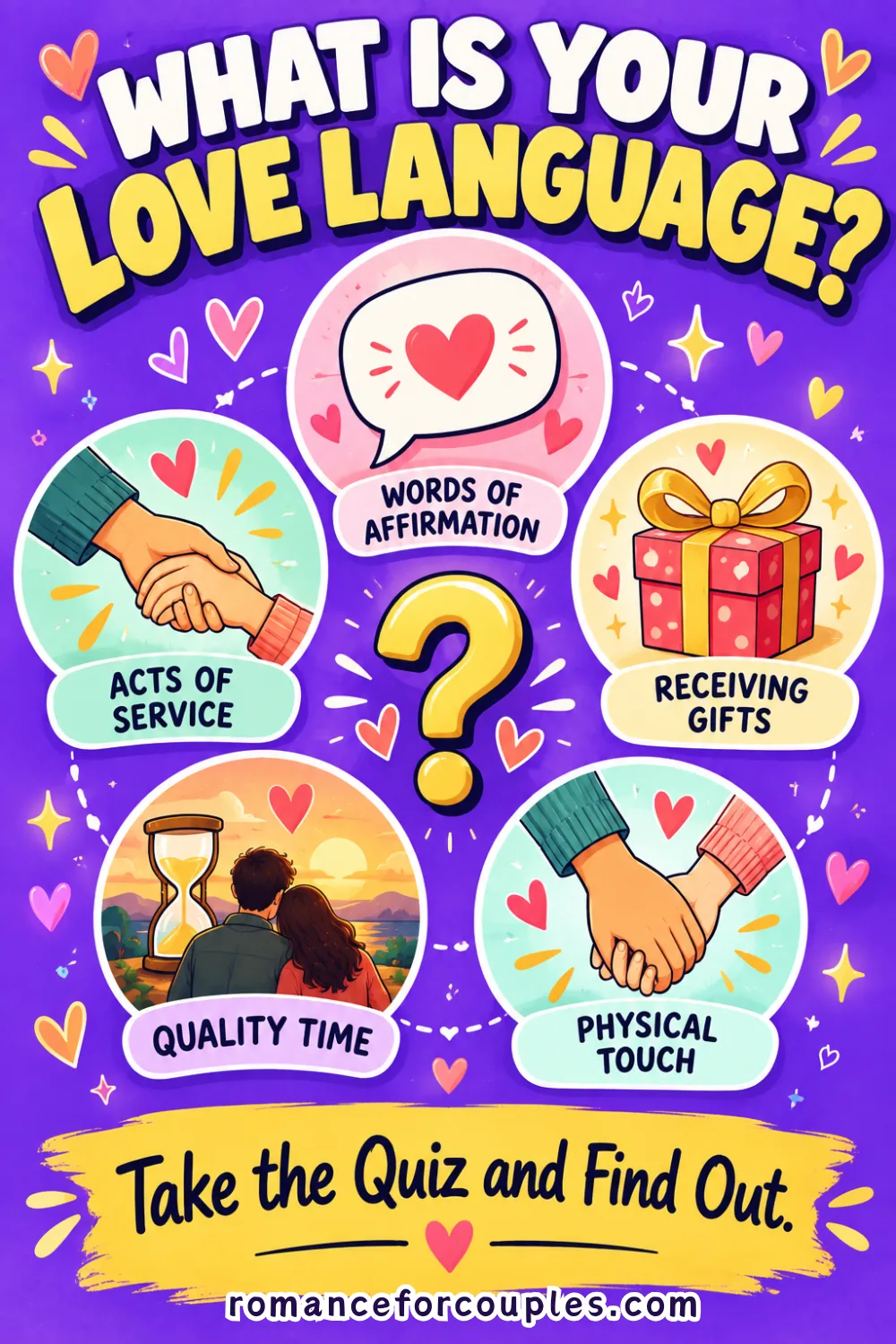
The meaning of a love language is simple: it's the way a person most naturally shows love and most easily feels loved. The five love languages are words of affirmation, quality time, acts of service, receiving gifts, and physical touch. Most people lean toward one or two, and partners often speak different ones without noticing.
This guide is for couples who keep trying hard and still somehow miss each other. Maybe you cook dinner every night while your partner wishes you'd just sit and talk. Maybe they buy you thoughtful little things when what you really want is a long hug. You'll get plain explanations of all five love languages, real examples of each, easy ways to figure out your own, and practical ideas for loving a partner whose language isn't yours.
- A love language is the type of loving gesture that registers most strongly with a person, such as kind words, focused time, practical help, gifts, or touch.
- Most people give love in the language they want to receive, which is why two caring partners can still feel unappreciated.
- You can spot your own love language by noticing what you ask for most, what you complain about most, and what hurts you most when it's missing.
- Partners with different love languages don't need to change who they are; they need to learn a few new habits and use them on purpose.
- Love languages work best alongside trust, honest communication, and respect for boundaries, not as a replacement for them.
What are the 5 love languages?
The 5 love languages are five broad styles of showing and receiving affection: words of affirmation, quality time, acts of service, receiving gifts, and physical touch. The idea was made popular by a well-known relationship book in the 1990s, and it caught on because it gives couples a simple vocabulary for something they already feel.
Think of a love language as your emotional "native tongue." You can understand the others, and you appreciate them, but one of them goes straight to your heart without translation. When your partner uses it, you feel seen. When it's missing for a long stretch, you feel lonely, even if they're doing plenty of other kind things.
Here's a quick-reference look at all five love language types.
| Love language | What it sounds like | A small way to show it | What tends to hurt |
|---|---|---|---|
| Words of affirmation | "Tell me what you love about me." | A specific compliment or a note on the mirror | Harsh criticism, silence, never hearing "thank you" |
| Quality time | "Be here with me, really here." | A phone-free walk or coffee together | Distracted listening, canceled plans |
| Acts of service | "Help me carry the load." | Handling a chore they dread without being asked | Broken promises, laziness, making more work |
| Receiving gifts | "You thought of me when I wasn't there." | A small treat picked out just for them | Forgotten birthdays, careless or last-minute gifts |
| Physical touch | "Stay close to me." | Holding hands, a long hug, a hand on the back | Coldness, pulling away, little or no affection |
The 5 ways of showing love, with real examples
Each love language has its own flavor, and the details matter more than the label. Below is what each one looks like in everyday life, plus examples you can borrow tonight.
Words of affirmation
Words of affirmation means love is felt most through what you say and write. For this person, a sincere compliment can carry them through a rough week, and a careless insult can stick for years. The key is being specific. "You look nice" is fine. "I love how you light up when you talk about your garden" is the kind of line they'll replay later.
- Praise effort, not just results. Notice how hard they worked on something, even if it didn't go perfectly.
- Say it out loud in front of others. A kind word about them at a family dinner can mean more than a private one.
- Leave it in writing. Texts, sticky notes, and cards give them something to reread on a hard day.
Our guide to words of affirmation as a love language goes deeper, with ideas for people who find compliments awkward to give.
Quality time
Quality time means love is felt most through undivided attention. It isn't about the hours you spend in the same room. Two people can sit on the same couch all evening while each one scrolls and still feel miles apart. What counts is presence: eye contact, real listening, and shared moments that belong only to the two of you.
- Protect a daily window. Even fifteen minutes of talking with phones in another room adds up.
- Do things side by side. Cooking together, walking the dog, or working a puzzle all count when you're both engaged.
- Plan ahead. A date on the calendar tells them they're a priority, not an afterthought.
If this sounds like your partner, the quality time love language guide has fifty specific ways to show it.
Acts of service
Acts of service means love is felt most through helpful actions. For this person, "Let me handle that" might be the most romantic sentence in the language. They notice who empties the dishwasher, who remembers to renew the car registration, and who steps in when they're overwhelmed.
- Take something off their list. Pick the chore they groan about most and quietly do it.
- Follow through. For this person, a promise you forget feels worse than never offering.
- Ask what would help. "What's one thing I could take care of this week?" is a gift in itself.
Receiving gifts
Receiving gifts means love is felt most through tangible symbols of thought. This one gets misunderstood as materialism, but it really isn't about cost. A pressed flower from your first walk together or a candy bar they mentioned once can mean more than anything expensive, because it proves you were paying attention.
- Keep a running list. When they mention something they like, jot it down in your phone.
- Bring back small souvenirs. A postcard or a smooth stone from a trip says "I missed you."
- Mark the moments. Birthdays and anniversaries matter more to this person than most.
Physical touch
Physical touch means love is felt most through warm, caring contact. Think hand-holding in the grocery store, a hug that lasts a few extra seconds, a head on a shoulder during a movie, or a squeeze of the hand under the table. For this person, affection is how they know everything is okay between you.
- Greet and part with a hug. Those small rituals at the door matter.
- Stay close during hard news. A hand on the arm can comfort more than any words.
- Respect their comfort level. Touch only works as love when it's welcome, so pay attention to what they enjoy.
How do you find out your love language?
You can find your love language by noticing what you ask for, what you complain about, and what makes you feel most cherished. A short love language quiz can speed things up, but your own patterns are the best evidence.
People search for a love language test, a love language exam, a love language questionnaire, or a full love language assessment test. They're all aiming at the same thing: a quick way to name what you already feel. Our free love language quiz asks simple either-or questions and shows your top language and runner-up in a few minutes. It's a great conversation starter, especially if you both take it and compare.
If you'd rather work it out yourself, try these steps.
- Remember your happiest relationship moments. Write down three times you felt deeply loved. Look for what they share. Was it something someone said, did, gave, or simply being together?
- Look at your complaints. What you grumble about most often points to what you need. "We never do anything together" is a quality time clue. "You never help" points to acts of service.
- Notice how you give love. Most of us give the kind of love we want. If you constantly buy little gifts, that may be your language too.
- Think about what hurts most. A forgotten birthday, a cold shoulder, a cutting remark, a broken promise: whichever stings worst probably sits closest to your love language.
- Ask your partner what they see. People who love us often notice our patterns before we do.
5 signs of each love language in your partner
The clearest signs of someone's love language are what they light up about and what they quietly ask for. Watch for these clues over a few weeks rather than judging from a single day.
- Words of affirmation clues: They save old cards, they ask "Do you like it?" a lot, and they seem crushed by criticism that others shrug off.
- Quality time clues: They get frustrated when you check your phone mid-conversation, and they remember the details of every trip you took together.
- Acts of service clues: They do a lot for others, they mention when no one helped, and they thank you warmly when you fix something.
- Receiving gifts clues: They keep ticket stubs and little mementos, they put real thought into presents, and an overlooked occasion hurts them deeply.
- Physical touch clues: They reach for your hand often, they sit close, and they seem uneasy when you're physically distant after a disagreement.
What happens when partners have different love languages?
When partners have different love languages, both can work hard at loving each other and still feel unappreciated. It's not a lack of love. It's a translation problem.
Picture this. Sam's love language is acts of service, so Sam shows love by fixing the leaky faucet, filling the gas tank, and packing lunches. Jordan's love language is quality time, so what Jordan wants most is for Sam to put down the tools and sit on the porch together. Sam feels unappreciated ("I do everything around here"). Jordan feels lonely ("You're always busy"). Both are right, and both are loving in good faith.
Mismatches like this are one of the most common sources of low-level conflict between happy couples. The fix usually isn't a big change. It's learning to give a little more in your partner's language, and naming what you're already giving so it gets noticed.
Try saying: "I've realized I show love by doing things for you, and I think you feel it most when we just spend time together. Can we figure out a way to have more of that?"
A mismatch can also be a gift. You each get to stretch, and you each learn new ways of showing love that make you a more generous partner overall.
How to love someone whose love language isn't yours
To love someone in a language that isn't your own, start small, be consistent, and ask for feedback. Grand gestures fade, but small daily habits change how loved a person feels.
A simple plan for couples
- Name both languages. Talk openly about which ones you each lean toward. Taking a quiz together helps because it's lighter than an emotional sit-down.
- Pick one daily habit each. For a touch person, a long hug when you get home. For a words person, one specific compliment a day. Keep it doable.
- Pick one weekly gesture. A planned date, a handwritten note, taking over a chore, or a small surprise.
- Say what you're doing, at first. "I wanted to take this off your plate" helps your partner connect the action to love while you're both learning.
- Check in after a month. Ask what's landing and what isn't. Adjust without taking it personally.
Words that help when the language feels awkward
If saying sweet things doesn't come naturally, borrow simple scripts until they feel like yours.
Try saying: "I noticed how patient you were with your sister today. I really admire that about you."
Try saying: "What would make this week easier for you? I'd like to take one thing on."
Try saying: "Can we have a phone-free dinner tonight? I miss just talking to you."
Need inspiration for quality time? Browse our date night ideas for plans that suit any mood or energy level. For couples who want easy prompts, the couples questions game turns ordinary evenings into real conversation.
Love languages during conflict, stress and hard seasons
Love languages matter most when life gets hard, because that's when people need emotional support the most and have the least energy to ask for it. Knowing your partner's language helps you comfort them in a way that actually reaches them.
During a disagreement, a words person may need to hear "I'm not going anywhere" before they can calm down. A touch person may soften the moment you sit next to them. An acts person may feel your apology most when you quietly fix the thing that caused the trouble. A quality time person needs you to stay in the conversation instead of leaving the room. A gifts person may appreciate a small peace offering, like their favorite snack, after a tense night.
Stressful seasons, like a new baby, a job loss, or caring for a sick parent, can also shift what someone needs. A partner who normally loves words might suddenly need acts of service because they're running on empty. It's worth checking in out loud: "What would feel most supportive right now?"
Common myths about love languages
Love languages are a helpful starting point, not a rulebook. A few common misunderstandings can turn a useful idea into a source of frustration.
- "I only have one language." Most people enjoy all five to some degree. Your top one or two simply carry the most weight.
- "If you loved me, you'd just know." Nobody reads minds. Telling your partner what fills you up is a form of trust, not a failure of romance.
- "My language means you owe me." A love language is information, not a demand. Using it to keep score tends to backfire.
- "Love languages can fix anything." They can't replace honest communication, shared goals, fair conflict, or respect. If bigger problems are present, those need direct attention.
- "Touch means anytime, anywhere." Everyone has limits. Healthy affection always respects the other person's boundaries in a relationship.
- "My language will never change." Life stages, stress, and age can all shift what feels most loving. Revisit the question every so often.
Why love languages help build appreciation and trust
Love languages help couples because they turn vague feelings into specific, doable actions. Instead of "I wish you cared more," you get "I feel close to you when we take walks," which is something a partner can actually do.
That shift builds appreciation on both sides. You start noticing efforts you used to overlook, like the coffee that's always ready or the extra squeeze of your hand. Your partner learns that their love is being received, which makes giving it feel good instead of thankless. Over time, those small exchanges become a steady layer of trust: you both know the other person is paying attention and trying.
The best part is that none of this requires a big budget, a dramatic gesture, or a personality change. It asks for curiosity, a few minutes a day, and the willingness to say, "Show me how you like to be loved."
Frequently asked questions
Can a person have two love languages?
Yes, and it's very common. Many people have a clear favorite and a close second, such as quality time and physical touch. Some find their top two are nearly tied. The useful takeaway is knowing which gestures matter most to you, so you can share that with your partner and notice when you're getting what you need.
Which love language is the most common?
There's no reliable count of which love language is most common, and it varies a lot from person to person. Many couples report that quality time and words of affirmation come up often, but your partner may be completely different. Instead of guessing from averages, ask them directly or take a short quiz together and compare your results.
Is a free love language test accurate?
A free love language test can be a helpful snapshot, but treat it as a starting point rather than a final verdict. Your answers can shift with your mood or a recent argument. The most accurate picture comes from combining a quiz result with your own patterns, what you ask for, and what hurts most when it's missing.
What if my partner and I have completely different love languages?
That's normal and very workable. Talk openly about what each of you needs, then choose one small daily habit and one weekly gesture in the other person's language. Name what you're doing at first so it gets noticed. After a few weeks, check in and adjust. Different languages can make both of you more thoughtful partners.
Can your love language change over time?
Yes. Many people find their needs shift with life stages, stress, health, or a new chapter like parenthood. Someone who once valued gifts may later crave practical help. It's worth revisiting the question every year or so, and especially after big life changes, so your partner isn't loving an older version of you.
Do love languages work for long-distance couples?
They do, with some creativity. Words travel easily through texts, voice notes, and letters. Quality time can happen over a shared video call or watching the same movie at once. Gifts can arrive by mail, and acts of service might mean handling an errand online for them. Touch is harder, so plan reunions and lean on the other four.
The kindest thing you can do this week is find out how your partner feels most loved, and tell them how you do too. Take our free Love Language Quiz together, compare your top two results over coffee, and pick one small new habit each. It's an easy, warm way to start loving each other in a language you both understand.