What attachment styles are
Attachment theory began in the 1950s and 1960s with the psychiatrist John Bowlby and the psychologist Mary Ainsworth, who studied how babies bond with the people who care for them. They noticed that some infants treated a parent as a secure base, happily exploring and returning for comfort, while others clung anxiously or seemed not to seek comfort at all.
In the late 1980s, researchers Cindy Hazan and Phillip Shaver found that the same patterns show up in adult romantic relationships. The way we learned to handle closeness as children often echoes in how we handle it with partners: how much we worry about being left, and how comfortable we are depending on someone.
Today, most researchers describe adult attachment using two dimensions rather than fixed boxes:
- Anxiety: how much you worry about rejection, abandonment and whether your partner really loves you.
- Avoidance: how uncomfortable you are with closeness, dependence and emotional openness.
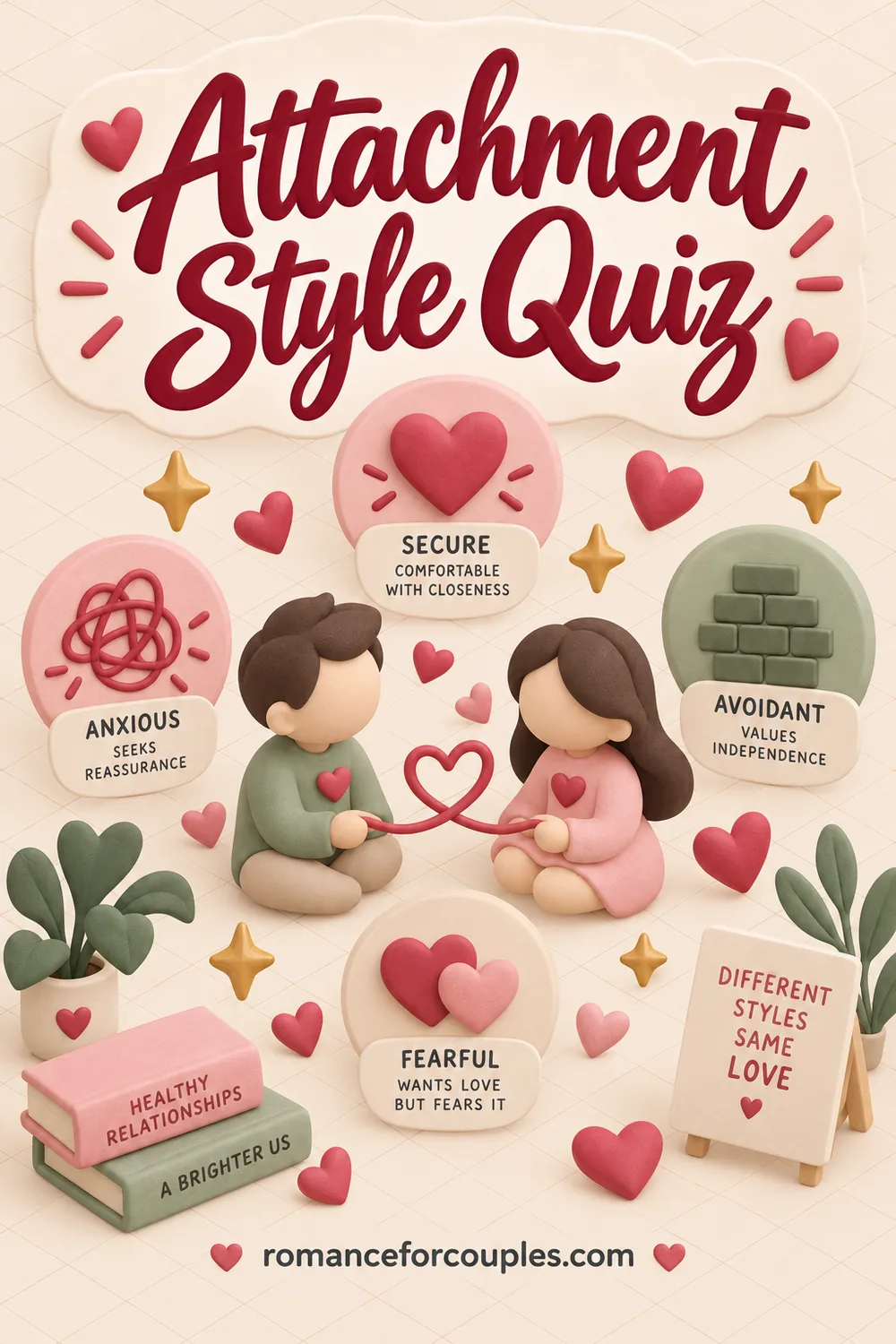
Where you fall on those two dimensions gives four broad styles. This four-part picture owes a lot to psychologist Kim Bartholomew, who in the early 1990s described adult attachment in terms of how people see themselves and how they see others, and named four patterns: secure, preoccupied, dismissing and fearful. The labels used below are the everyday versions of those same four.
| Style | Anxiety | Avoidance | In short |
|---|---|---|---|
| Secure | Low | Low | Comfortable with closeness and with independence. |
| Anxious | High | Low | Wants closeness, worries it will be lost. |
| Avoidant | Low | High | Values independence, uneasy with dependence. |
| Fearful-avoidant | High | High | Wants closeness and fears it at the same time. |
How this quiz works
You rate 24 statements from 1 (strongly disagree) to 7 (strongly agree). Twelve statements measure anxiety and twelve measure avoidance, and they are mixed together so the pattern is not obvious.
Some of the statements on each scale are worded in reverse: three of the twelve anxiety statements and five of the twelve avoidance statements. For example, "I rarely worry about my partner leaving me" is the opposite of an anxious statement, so agreeing with it lowers your anxiety score. Behind the scenes, a reversed answer is flipped, so a 6 counts as a 2 and a 7 counts as a 1. This is a standard way of making sure people who agree with everything, or disagree with everything, do not get a misleading result.
Your answers are averaged into two scores between 1 and 7. The midpoint, 4, divides low from high: anything below 4 counts as low, and 4 or above counts as high. Your result shows exactly where you sit on a simple chart, so you can see not just your style but how strongly you lean into it. If you tap the wrong number, the Back button lets you return to the previous statement and change it.
How to read your result
Look at the dot, not just the label. Someone who scores 4.1 on anxiety and someone who scores 6.8 both land in the "anxious" half, but their experience of relationships is very different. If your dot sits close to a dividing line, the quiz will tell you, and it is worth reading the neighboring style as well.
Secure does not mean perfect. Securely attached people still get hurt, jealous and frustrated. The difference is that those feelings do not usually take over, and conflict does not feel like the end of the world.
Insecure styles are not flaws. Anxious and avoidant patterns are strategies that once made sense. A child who learned that crying brought comfort only sometimes may become an anxious adult who keeps checking. A child who learned that needs were ignored may become an avoidant adult who stops asking. Understanding the pattern is the first step to softening it.
When two styles meet
Attachment styles are most interesting in pairs. Some common combinations:
- Anxious and avoidant: the most famous pairing, and often the most painful. One partner reaches for closeness, the other pulls back, which makes the first reach harder, which makes the second pull back further. Both partners are reacting to feeling unsafe. Naming the cycle together can break it.
- Secure and anything: a secure partner often has a steadying effect. Over time, people in a relationship with a consistently secure partner tend to become more secure themselves.
- Anxious and anxious: lots of closeness and lots of reassurance, but worries can feed off each other during a conflict.
- Avoidant and avoidant: calm and respectful of each other's space, but it can be hard for either person to go first when something important needs saying.
If you want to go further, our guide to anxious attachment in relationships explains what that pattern feels like from the inside and what genuinely helps.
Can your attachment style change?
Yes. Attachment styles are fairly stable, but they are not fixed. Researchers describe something called earned security: people who started with an insecure style and became more secure over time. The things that help most are a steady, reliable relationship, a close friendship or two, self-awareness, and, for many people, working with a counselor or therapist.
Your style can also look different with different people, and it can shift during stressful periods such as a move, a new baby or a loss. Retaking the quiz after a year can be revealing.
What this quiz is not
This is a reflection tool. It uses the same two-dimension idea that researchers use, but it is not a clinical assessment, and an online quiz cannot diagnose anything. If you recognize the fearful-avoidant pattern strongly, or if your relationships feel consistently frightening or painful, please consider talking to a qualified counselor or therapist. And if you ever feel unsafe with a partner, reach out to a local support line or emergency services.
Reading a real result: a worked example
Numbers on a chart can feel abstract, so here is how two made-up results would come out.
Example one: Jordan. Jordan's anxiety score is 5.4 and avoidance is 2.3. Anxiety is well above the midpoint of 4, and avoidance is well below it, so the dot sits firmly in the top-left corner of the chart and the result reads "Your attachment style is Anxious". The low avoidance matters as much as the high anxiety: Jordan is not uneasy with closeness at all. The worry is about losing it. In practice that might look like rereading messages, feeling unsettled when plans are vague, and feeling much calmer once a partner is clear and consistent.
Example two: Riley. Riley's anxiety score is 3.8 and avoidance is 4.9. Avoidance is clearly high, but anxiety is only about 0.2 below the midpoint. Because at least one score is within 0.4 of 4, the headline changes from "Your attachment style is" to "You lean toward", and the result reads "You lean toward Avoidant", with a note to read the neighboring style too. For Riley, that neighbor is fearful-avoidant. Riley mostly values space and self-reliance but also has more worry about rejection than a typical avoidant person, and may recognize a bit of the push-pull pattern during hard times.
The lesson from both examples: read your two numbers, not just the label. Two people with the same label can have quite different days.
What each style can look like day to day
The result screen gives you a summary of your style, how it tends to show up in relationships, and a few things that help. Here is a closer look at all four from a slightly different angle: what a partner might notice, and what tends to help or hurt when you love someone with that style.
Secure
What a partner notices: steady replies, plans that happen when they said they would, and the ability to say "I'm upset about this" without it turning into a crisis. Secure partners can enjoy a weekend apart and a weekend together equally.
What helps: honesty and follow-through. Secure people usually respond well to plain talk.
What hurts: being treated as the "easy one" whose needs never come first. Secure people still need care, especially when life gets hard.
Anxious
What a partner notices: warmth, attention and a lot of care, along with quick worry when something feels off. A change in tone or a late reply can set off a chain of questions.
What helps: predictability. Saying when you will be back, replying to say you are busy rather than going silent, and naming affection out loud all go a long way.
What hurts: being told they are "too much", or having reassurance given grudgingly. Our longer guide to anxious attachment covers this style in depth.
Avoidant
What a partner notices: calm, capable and independent, with care often shown through practical help rather than emotional talk. They may go quiet under stress and need time alone to process.
What helps: space that is offered, not demanded. Hard talks go better side by side, on a walk or in the car, than face to face across a table. Giving them a heads-up before a serious conversation also helps.
What hurts: being chased when they pull back, or having every feeling analyzed. Pressure tends to make them retreat further.
Fearful-avoidant
What a partner notices: deep feeling and a strong wish for closeness, sometimes followed by sudden distance. Mixed signals are common, and they are usually as confusing to the person sending them as to the person receiving them.
What helps: a slow, steady pace, calm responses when things feel shaky, and a partner who stays consistent without pushing. Professional support is often especially helpful with this style.
What hurts: unpredictability, raised voices, and ultimatums. Anything that feels threatening can set off the urge to run.
More pairings, and how to meet in the middle
The pairings above describe common patterns. Here are a few more, with small, practical agreements that help each couple find a middle ground.
| Pairing | A common sticking point | A middle-ground agreement |
|---|---|---|
| Anxious + avoidant | One needs to talk right now, the other needs to step away. | Agree on a "pause with a return time": the avoidant partner can take space, but says when they will come back, and keeps that promise. |
| Anxious + fearful-avoidant | Both worry about being left, but one also pulls away when things get close. | Keep a gentle daily check-in, and agree that pulling back for a bit does not mean the relationship is over. |
| Avoidant + fearful-avoidant | Both can go quiet, so important things go unsaid. | Set a regular, low-pressure time each week to share one thing on your mind, even a small one. |
| Secure + secure | Very little, but comfort can drift into taking each other for granted. | Keep doing the small things on purpose: dates, thank-yous, and curiosity about each other. |
| Secure + insecure style | The secure partner may run out of patience, or feel like the only one steering. | The secure partner stays consistent; the other names their pattern out loud when it shows up, instead of acting it out. |
Whatever your pairing, the most helpful single step is often the simplest: describe your pattern to your partner while you are both calm, so that when it shows up during a hard moment, you already share the words for it.
Taking it as a couple
This quiz does not have a partner link, so the easiest way to compare is for each of you to take it on your own phone, then put your results side by side. Answer on your own first, without discussing it, so you do not nudge each other's answers. Then look at both charts together and try a few of these questions:
- Does your result match how you see yourself, and how I see you?
- When you feel far from me, what do you usually do? What would you like me to do?
- What is something I do that makes you feel safe with me?
- Is there a small habit of mine that sets off worry or pressure for you?
- When we argue, would you rather talk right away or take a break first? How long a break?
- What did closeness and comfort look like when you were growing up?
Go gently. These can be tender subjects, and the aim is understanding, not proving who has the "better" style. If you want lighter prompts to warm up with, the Couples Questions Game is a good place to start, and the Love Language Quiz is a nice follow-up that does let you send a comparison link.
Signs it may be time for extra support
An online quiz can help you notice a pattern, but some patterns are easier to change with help. It may be worth talking to a counselor or therapist, on your own or as a couple, if:
- worry about your relationship takes up a large part of most days;
- you find yourself ending relationships, or pushing people away, whenever they start to matter;
- the same painful cycle keeps repeating even though you both understand it;
- old experiences, such as loss, neglect or hurt in childhood, feel like they still have a strong hold on you.
None of these mean something is wrong with you. They simply mean you deserve support. And again, if a partner ever frightens, threatens or controls you, that is not an attachment style difference. Please reach out to a trusted person, a local support line, or emergency services.
Frequently asked questions
What are the four attachment styles?
Secure, anxious (sometimes called anxious-preoccupied), avoidant (sometimes called dismissive-avoidant) and fearful-avoidant (sometimes called disorganized).
Which attachment style is most common?
Secure attachment usually comes out as the most common style in research on adults, with the rest spread across the insecure styles. The exact share varies from study to study.
Is it bad to be avoidant or anxious?
No. They are patterns, not character flaws. Plenty of people with insecure styles have loving, lasting relationships, especially when both partners understand what is going on.
Should I answer about my current partner?
Answer about how you tend to feel in romantic relationships in general. If you are in a relationship now, it is fine to lean on that, but try not to let one great or one terrible week decide your answers.
Why does my result say "You lean toward"?
That wording appears when at least one of your scores is within 0.4 of the midpoint of 4. It means you sit near the border between two styles, so it is worth reading the neighboring style as well.
Can I send my result to my partner?
Not from this quiz. The simplest way to compare is for each of you to take it separately and then look at your charts together.
Why do some statements seem to ask the same thing twice?
Several statements are worded in opposite directions on purpose. Reversed statements help catch the habit of agreeing, or disagreeing, with everything, which makes your final scores more accurate.
Can I have a different style with different people?
Yes. Many people feel more secure with one partner than another, or more anxious in a new relationship than in a long one. That is one reason the quiz asks about relationships in general.
Are my answers stored?
No. Every answer stays on your device, and nothing is sent to us.