What a love language is
A love language is the way you most naturally give and receive love. The idea comes from marriage counselor Gary Chapman, who noticed in his 1992 book that couples often love each other sincerely but in ways the other person does not quite register. One partner cleans the whole kitchen as a gesture of love; the other would rather have heard "I love you" and been hugged at the door. Both are trying. Neither feels it.
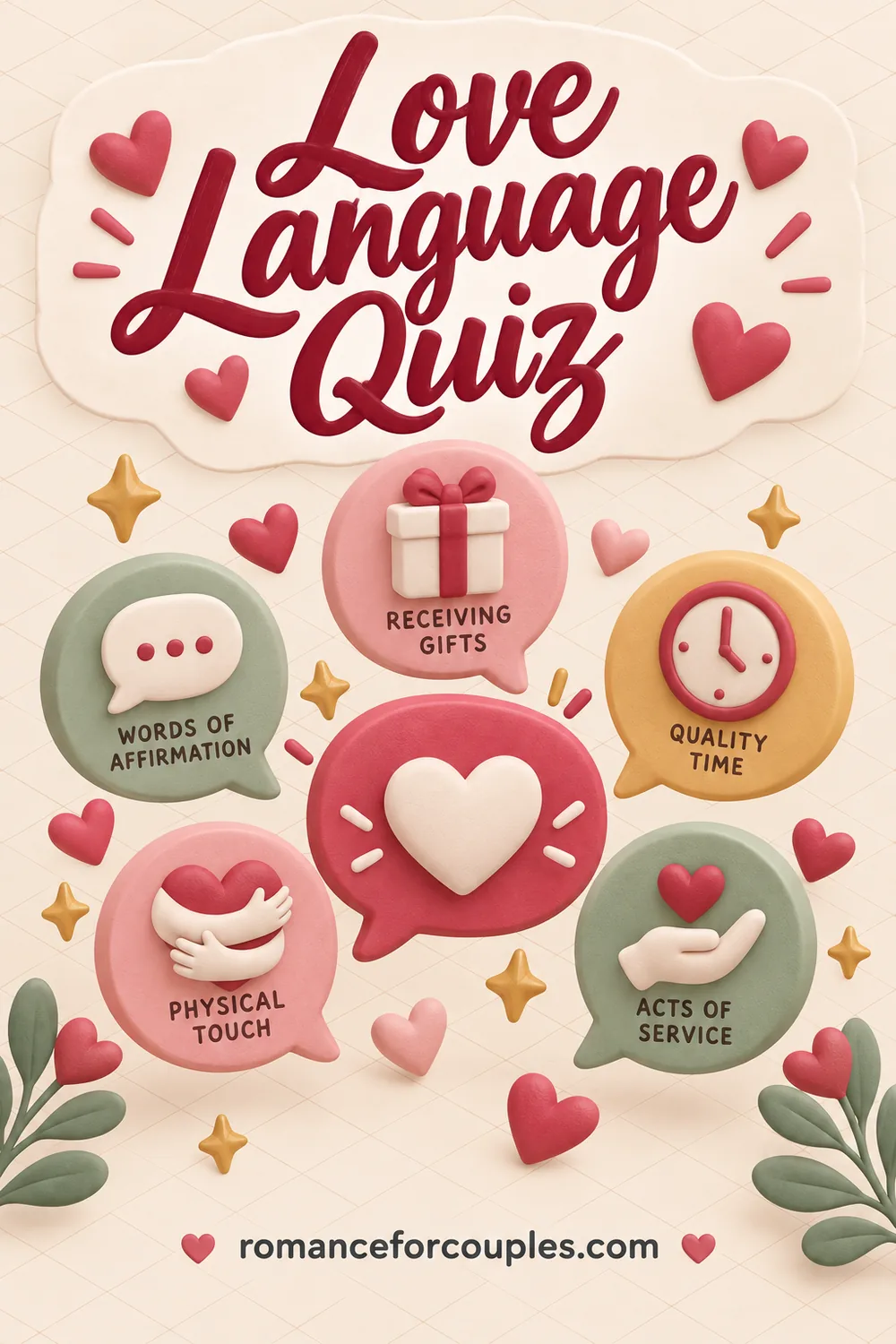
Chapman grouped the ways people express love into five categories:
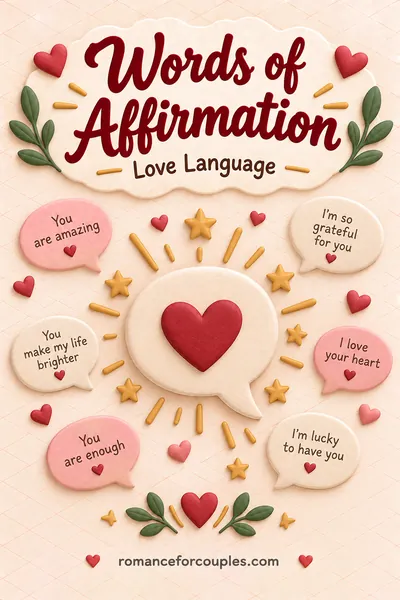
- Words of affirmation: compliments, encouragement, "I love you", "I'm proud of you".
- Quality time: undivided attention, real conversation, doing things together.
- Receiving gifts: thoughtful tokens that prove you were thought of.
- Acts of service: doing things that lighten the other person's load.
- Physical touch: hugs, holding hands, closeness and affection.
Most people respond to all five to some degree, but one or two usually matter far more than the others. Knowing which is which, for both of you, turns a lot of well-meant effort into effort that actually lands.
How this quiz works
You get 30 questions, and each one shows two things a partner might do for you. You pick the one that would mean more. It is deliberately a forced choice, because asking people to rate each thing out of ten tends to produce "all of them, please", which is true but not useful.
The quiz is carefully balanced. There are ten possible pairings of the five languages, such as words against touch, or gifts against time, and every pairing appears exactly three times. That means each language has exactly twelve chances to be chosen, so none of them is favored by the way the questions are set up. The order is mixed so you cannot tell which pairing is coming next.
Your result shows a score out of 12 for each language, from your strongest to your weakest. Because every question gives exactly one point to one language, your five scores always add up to 30. If you tap the wrong answer, the Back button takes you to the previous question so you can change it. The whole thing takes about four minutes.
How to read your result
Your top language is the one your partner should pay the most attention to. When they express love this way, you will feel it most clearly. When it is missing, you may feel unloved even if they are doing plenty of other things.
Your second language matters too. Many people have two languages close together, and scores within one or two points of each other are effectively a tie.
Your lowest language is interesting for a different reason. It is often the one you forget to give, because it does not mean much to you. If it happens to be your partner's top language, you have found the source of a lot of misunderstandings.
If your scores are close together
A flat profile, where every language scores between five and eight, simply means you appreciate love in many forms. It is not a failed quiz. In that case, look at which situations matter most: what you want when you are stressed, for example, can be different from what you want on an ordinary day.
Comparing with your partner
This is where the quiz becomes genuinely useful. When you finish, you can type your first name and tap "Send to my partner". On a phone this opens your usual share options, so you can send it by text or chat; on a computer it copies a short message and the link so you can paste it anywhere. When your partner opens the link, they see a note saying you shared your result, and once they finish the quiz they see both results side by side, along with specific ideas for loving you.
One thing to know: the side-by-side view appears on the screen of the person who opened the link, not the person who sent it. The easiest way to handle that is to sit together while the second person finishes, or have them take a screenshot of the comparison and send it back.
The most common pattern is that each person gives love in their own language. Someone who feels loved through acts of service will show love by doing things, and may be baffled that their partner still feels neglected. Seeing the two profiles next to each other usually makes that obvious in a way that no argument ever does.
A few ways to use the comparison:
- Each pick one thing from the other person's tip list and do it every day for a week.
- Talk about your lowest language and whether it has ever caused friction.
- Agree on a small signal for "I need my love language today", especially for stressful weeks.
A few honest caveats
The love languages are a popular and helpful way to talk about affection, but they are a framework, not a scientific test. Research on them is mixed: studies have found that people do not always fall neatly into one category, and that couples who express love in lots of ways tend to be happiest overall. Treat the result as a conversation starter rather than a label.
Your love language can also shift with life. New parents often find that acts of service suddenly matter enormously. Long-distance couples may find quality time and words move to the top. It is worth retaking the quiz every year or two.
Finally, the five categories cover affection, not respect or safety. No love language excuses being unkind, controlling or dishonest.
Reading a real result: a worked example
Here is how one made-up but typical result might look, and how to make sense of it. Say Maya finishes the quiz with these scores:
| Language | Score | What it suggests |
|---|---|---|
| Quality time | 10/12 | Her clear top language. Attention is what she notices first. |
| Physical touch | 8/12 | A strong second. Closeness matters a lot to her too. |
| Words of affirmation | 6/12 | Right in the middle. Nice to hear, but not essential. |
| Acts of service | 4/12 | Appreciated, but rarely what makes her feel loved. |
| Receiving gifts | 2/12 | Her lowest. She may forget that gifts can matter hugely to others. |
Her result screen would lead with "Your love language is Quality time", followed by bars for all five, an explanation of what quality time means and what tends to hurt, a short panel on her second language, and a list of ideas to show her partner.
The useful reading goes a little further than the headline. Her top two are both about presence: being with someone, and being close to them. A partner who works late all week and then brings her a lovely present on Friday is working hard in her two lowest languages. She may be grateful and still feel lonely. On the other hand, a partner who spends twenty phone-free minutes on the couch with her every evening, sitting close, is covering her top two at once, without any special effort or planning.
Now imagine her partner, Sam, scores highest in acts of service and lowest in quality time. That is a very common and very fixable mismatch. Sam is probably showing love by handling chores, and may feel unappreciated when Maya asks for more time together instead of noticing the clean kitchen. Neither is wrong. They just need to know which currency the other one counts in.
If your top two scores are identical, the result will say your love languages are a tie and name both. That is not a glitch. It means both deserve equal attention from your partner.
What each love language looks like day to day
The result screen gives you tips for your top language. Here is a broader look at all five, including the small, everyday habits that tend to help and the common slip-ups that quietly hurt.
Words of affirmation
People who score high here keep kind messages, remember compliments for years, and are often just as affected by harsh words. Day to day, it looks like a partner who notices effort and says so, and who does not assume that love goes without saying. A quick "thank you for handling that" at the end of the day counts for more than you would guess. If putting feelings into words does not come naturally, the Love Letter Maker can help you get started. The full guide to words of affirmation has many more examples.
Quality time
This is about attention rather than hours. A long day spent in the same room while both of you scroll does not count for much; a short walk with real conversation does. Helpful habits include a protected evening each week, eating together without screens, and remembering what they told you yesterday so you can ask how it went. What hurts most is being half-listened to, or having shared plans treated as the first thing to cancel. For fresh ideas that do not need much planning, try the Date Generator.
Receiving gifts
This one is the most misunderstood, because it sounds like it is about things. It is really about being remembered. A gift says "I was thinking about you when you were not there", and people who value it tend to notice how much thought went into a present rather than what it is. Everyday versions are tiny: a favorite tea picked up on the way home, a leaf from a walk, a funny postcard. What hurts is being forgotten on the days that matter, or receiving something that shows no one was paying attention.
Acts of service
For these people, love is a verb. They feel cared for when their load gets lighter, and they notice when it does not. The key is doing things without being asked, and doing what you said you would do. A partner who says "I've got the dishes tonight, go sit down" is speaking fluently. The biggest hurt is the feeling of carrying everything alone, or having to remind someone three times about a promise.
Physical touch
People with this language feel connection through their body first. A hand on the back while passing in the kitchen, a hug that lasts longer than a second, sitting with legs touching on the couch: these are how they feel close and safe. Touch here is mostly everyday affection, not only intimacy. What hurts is a partner who goes stiff or pulls away, especially during an argument, since distance at that moment can feel like being shut out completely. Of course, touch should always be welcome for both people, and it is fine to talk about what kinds feel good and when.
When your top languages differ
Most couples do not share a top language, and that is fine. It simply means each of you has something new to learn. Here are some common combinations and a simple way to meet in the middle for each.
| Pairing | Where it goes wrong | Meeting in the middle |
|---|---|---|
| Words + Acts of service | One says "I love you" often, the other shows it by doing things. Each feels the other's love is missing. | The service partner says out loud what they did and why ("I filled your car because you've had a long week"). The words partner thanks them for specific tasks. |
| Quality time + Acts of service | One wants to sit together, the other keeps busy fixing and tidying. | Do chores side by side. Cooking together or running errands as a pair covers both at once. |
| Physical touch + Words | One reaches for a hug, the other wants to talk it through. | Talk while holding hands, or hug first and then talk. |
| Receiving gifts + Quality time | One remembers every occasion with a present, the other would rather have a free afternoon together. | Make the gift an experience: a day out, a picnic, or a plan for an evening together. |
| Physical touch + Quality time | Usually an easy match, but busy weeks squeeze out both at once. | Build in small daily rituals, like coffee together in the morning with no phones. |
A good rule for any pairing: give your partner what they need in their language, and ask for what you need in yours. Saying "I'd love a hug right now" or "could we have an evening just for us this week?" is not needy. It is helpful information for someone who wants to get it right.
Questions to talk about after you both take it
A quiz result is most useful as the start of a conversation. Pick a relaxed moment, not the middle of a disagreement, and try a few of these:
- Did your result surprise you, or did it confirm something you already knew?
- What is one time recently when you felt really loved by me? What exactly did I do?
- Which of my habits do you think I do out of love, even if it doesn't look like it?
- Is there something I do often that you'd happily swap for something else?
- When you are stressed or sad, what do you want most from me?
- What did affection look like in the home you grew up in?
- What is one small thing I could do every day this month?
For more ways to keep talking, the Couples Questions Game has plenty of prompts to use on a quiet evening.
When a quiz is not enough
Learning each other's love languages can smooth out a lot of everyday friction. It cannot fix everything. If you have both tried to speak each other's language for a while and still feel distant, or if the same arguments keep coming back no matter what either of you does, a couples counselor can help you see what is going on underneath. Asking for that kind of help is a sign that the relationship matters to you, not a sign that it has failed.
And if you ever feel afraid of your partner, or feel controlled, belittled or unsafe, that is not a love language problem. Please reach out to someone you trust, a local support line, or emergency services.
Frequently asked questions
What are the five love languages?
Words of affirmation, quality time, receiving gifts, acts of service and physical touch.
Can you have two love languages?
Yes, and many people do. If your top two scores are within a point or two, treat them as equally important.
Does "receiving gifts" mean someone is materialistic?
No. It is about thoughtfulness, not money. A pebble from a beach walk can mean more than anything expensive, because it shows you were remembered.
Is this the official love languages quiz?
No. This is our own free quiz, written independently to give each of the five languages an equal chance. The five categories were first described by Gary Chapman.
How long does the quiz take?
About four minutes. There are 30 questions, and each one only needs a single tap. Go with your first instinct rather than thinking each one through.
What happens if two of my languages get the same score?
If your top two are exactly equal, your result says your love languages are a tie and shows both names. Your partner should treat them as equally important.
Can my partner see which answers I picked?
No. The link you send only carries your five scores and, if you add it, your first name. Your partner never sees your individual choices.
What if I would honestly pick both options?
That is normal, and it happens a lot. Pick the one that would mean slightly more to you today. Across 30 questions, those small leanings add up to a clear picture.
Are my answers saved?
No. The quiz runs on your device. If you send your result to a partner, only your five scores and the first name you choose are placed in the link, and nothing is stored on our side.
For something much sillier, try the Love Calculator, the classic name game. Once you know your language, the guide to words of affirmation goes much deeper into the most misunderstood of the five.