How the zodiac compatibility calculator works
Pick your sign and your partner's sign, or type in a birthday if you are not sure which sign it falls under, and the calculator compares them the way astrologers traditionally compare sun signs. There is no hidden random number in here. The same two signs always give the same result, and every part of the result comes with the reason behind it.
Three things decide the reading.
1. The distance between your signs
The zodiac is a wheel of twelve signs, and the angle between two signs on that wheel is called an aspect. It is the oldest and most important idea in astrological compatibility, and it sets the percentage you see.
| Signs apart | Aspect | Score | What it usually means |
|---|---|---|---|
| 4 | Trine | 92% | Same element. Natural understanding and easy flow. |
| 2 | Sextile | 85% | Complementary elements. Friendly, playful and supportive. |
| 0 | Same sign | 76% | Instant recognition, shared strengths and shared blind spots. |
| 6 | Opposition | 73% | Magnetic attraction between opposites. Balance takes work. |
| 1 | Next-door signs | 58% | Different elements and modes. Lots to learn from each other. |
| 3 | Square | 54% | Friction, chemistry and growth. Rarely boring. |
| 5 | Quincunx | 49% | Nothing in common structurally. Works when both people stay curious. |
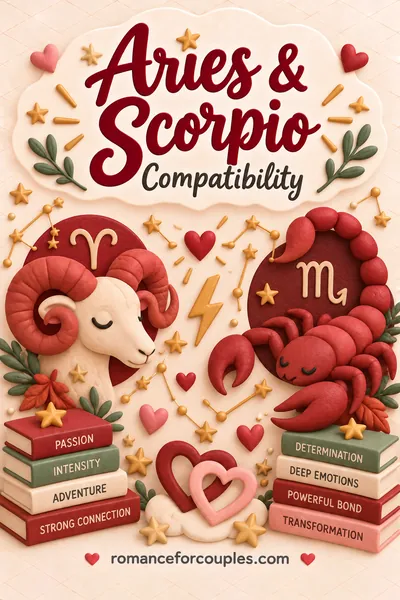
A lower number is not a verdict. Aries and Scorpio, for example, score 49 percent yet are famous for their chemistry, because both are traditionally ruled by Mars. Astrologers often say that square and quincunx couples have the most interesting relationships, because they are built on difference rather than sameness.
2. Your elements
Every sign belongs to one of four elements, and the element describes a basic temperament.
- Fire (Aries, Leo, Sagittarius): energetic, direct, enthusiastic, quick to act.
- Earth (Taurus, Virgo, Capricorn): grounded, practical, loyal, focused on security.
- Air (Gemini, Libra, Aquarius): curious, social, talkative, led by ideas.
- Water (Cancer, Scorpio, Pisces): emotional, intuitive, protective, led by feelings.
Fire and air feed each other, and so do earth and water. Fire and water, or earth and air, tend to create more friction. The calculator explains where your particular pair of elements clicks, where it tends to clash, and one practical thing to try.
3. Your modes
Each sign also has a mode, sometimes called a modality or quality, which describes how it acts. Cardinal signs (Aries, Cancer, Libra, Capricorn) like to start things. Fixed signs (Taurus, Leo, Scorpio, Aquarius) like to hold steady and finish them. Mutable signs (Gemini, Virgo, Sagittarius, Pisces) adapt and adjust. Two people with the same mode share a rhythm; two different modes can divide the work between them.
How to read your result
Your result has four parts. The headline percentage and label come from the aspect. The first panel explains what that aspect is like to live with day to day. The elements panel tells you where the two of you naturally connect and where you are most likely to rub each other the wrong way. Finally, there is a short profile for each sign covering what it brings to love, what it needs, and what to watch for.
The most useful part is often the "watch for" line. If you are an Aries dating a Cancer, knowing that Aries tends toward impatience and Cancer tends to go quiet when hurt explains a lot of arguments before they happen.
What sun signs can and can't tell you
Your sun sign is the sign the sun was in on the day you were born. It is the sign you read in horoscope columns, and it says something about your core personality. But it is only one piece of a birth chart. Astrologers also look at the moon sign, which describes emotional needs, Venus, which describes how you love, Mars, which describes desire and anger, and the rising sign, which describes how you come across.
That is why two couples with exactly the same sun signs can have completely different relationships. A sun-sign reading is a good conversation starter and a fun lens, but a full comparison of two birth charts, called synastry, goes much deeper.
It is also worth saying plainly: astrology is a tradition, not a science. There is no good evidence that sun signs predict whether a relationship will last. Plenty of "incompatible" couples have been happily married for fifty years. Use the result as a way to talk about how you both approach love, not as a reason to stay or leave.
Tips for getting the most out of it
- Check the date cutoffs. If you were born on the first or last day of a sign, the exact changeover can shift by a day from year to year. The birthday box uses the standard dates, but someone born right on the edge, called a cusp, may want to read both signs.
- Read both profiles out loud together. Ask your partner whether the "needs" line for their sign is true. The answer is usually more interesting than the score.
- Share the link. After you get a result, the page address changes to include both signs, so you can send the exact reading to your partner or a friend.
- Try your exes and your friends. It is surprisingly revealing to see which pairings keep coming up in your life.
Two worked examples
It helps to see a full reading from start to finish, so here are two pairs that land at very different places on the scale.
Taurus and Scorpio: 73 percent, "Strong potential"
Taurus is the second sign on the wheel and Scorpio is the eighth, so they sit six signs apart, directly across from each other. That makes them an opposition, which scores 73 percent and earns the label "Strong potential."
The elements panel is headed "Earth and Water," one of the two naturally supportive element pairings. It tells this couple that earth gives water a safe place to land while water keeps earth from drying out, and it warns that both of you can hide inside a comfortable routine instead of dealing with anything awkward. Underneath that, the modes line points out that you are both fixed signs, which means deep loyalty and equally deep stubbornness. The "One thing to try" panel suggests talking about the future out loud, since you probably want the same things and simply haven't said so.
Then come the two profiles. Taurus is ruled by Venus and Scorpio by Pluto and Mars, and the "watch for" lines are stubbornness for Taurus and jealousy for Scorpio. Put those two side by side and you can probably guess what this couple's arguments look like: two people who refuse to budge, with one quietly keeping score. That is a useful thing to name early, and a lot more helpful than the number itself.
Gemini and Capricorn: 49 percent, "A real challenge, and a real teacher"
Gemini is the third sign and Capricorn is the tenth. Counting the short way around the wheel, they are five signs apart, which makes them a quincunx, the lowest score the calculator gives.
The elements panel reads "Air and Earth." Air brings the new ideas and earth turns them into something real, but earth can find air flighty and air can find earth rigid. The modes line notes that one of you is cardinal, the sign that sets direction, and the other is mutable, the sign that adapts. The suggestion here is to divide things by strength: Gemini handles the people and the ideas, Capricorn handles the plan and the details.
Read that way, a 49 percent pair looks less like a warning and more like a job description. Plenty of couples who seem mismatched on paper work well precisely because each person covers the other's weak spot.
Every sign's best-scoring partners
Because the score depends only on the distance between two signs, you can work out every sign's top matches without pressing a button. This table shows the trine partners (92 percent), the sextile partners (85 percent) and the opposite sign (73 percent) for all twelve signs.
| Sign | Element and mode | Trines (92%) | Sextiles (85%) | Opposite (73%) |
|---|---|---|---|---|
| Aries | Fire, cardinal | Leo, Sagittarius | Gemini, Aquarius | Libra |
| Taurus | Earth, fixed | Virgo, Capricorn | Cancer, Pisces | Scorpio |
| Gemini | Air, mutable | Libra, Aquarius | Aries, Leo | Sagittarius |
| Cancer | Water, cardinal | Scorpio, Pisces | Taurus, Virgo | Capricorn |
| Leo | Fire, fixed | Aries, Sagittarius | Gemini, Libra | Aquarius |
| Virgo | Earth, mutable | Taurus, Capricorn | Cancer, Scorpio | Pisces |
| Libra | Air, cardinal | Gemini, Aquarius | Leo, Sagittarius | Aries |
| Scorpio | Water, fixed | Cancer, Pisces | Virgo, Capricorn | Taurus |
| Sagittarius | Fire, mutable | Aries, Leo | Libra, Aquarius | Gemini |
| Capricorn | Earth, cardinal | Taurus, Virgo | Scorpio, Pisces | Cancer |
| Aquarius | Air, fixed | Gemini, Libra | Aries, Sagittarius | Leo |
| Pisces | Water, mutable | Cancer, Scorpio | Taurus, Capricorn | Virgo |
Here is something people rarely notice: every sign has exactly the same spread of possible scores. Out of the twelve signs you could pair with, each sign has two trines, two sextiles, two squares, two quincunxes, two next-door neighbors, one opposite, and itself. No sign is luckier in love than any other. If a friend insists their sign is "cursed" in relationships, this is a gentle way to prove otherwise.
Where this way of matching signs comes from
The method behind the calculator is very old. The twelve signs and their four elements come from ancient Greek and Hellenistic astrology, and the idea of reading meaning from the angle between two points on the zodiac wheel was already well established when the astronomer Ptolemy wrote about it in the second century. The main angles he described are the backbone of this calculator: the trine, the sextile, the square and the opposition, along with two points sitting together in the same sign. The quincunx and the next-door pairing were not among his main angles, and astrologers today still tend to describe them as the more awkward pairings.
The modes follow the seasons. In the Northern Hemisphere, the cardinal signs begin each season (Aries opens spring, Cancer summer, Libra fall and Capricorn winter), the fixed signs fall in the middle of each season, and the mutable signs close it out as the weather turns. That is where the idea of starters, holders and adapters comes from.
Comparing couples by sun sign alone is a much newer habit. It grew out of newspaper horoscope columns, which became popular in the twentieth century and needed a simple system that worked with nothing more than a birthday. Sun signs made astrology easy to share, which is exactly why they are still the version most people know today.
Talking about your result together
The score gets the laugh, but the profiles are what start the real conversation. Try going through these questions together after you get a reading:
- Does your "In love" line sound like you? Ask your partner to answer for you, then compare with your own answer.
- Is your "Needs" line true right now? Needs change. Someone who once wanted lots of freedom may want more security after a hard year, and it is worth saying so.
- Which "Watch for" line shows up in your arguments? Keep this one light. The point is to spot a pattern together, not to hand your partner a list of their faults.
- Would you try the "One thing to try" suggestion? If it sounds good, pick a day this week and do it.
- Where does the reading get you completely wrong? This is often the best question of all, because it tells you something the astrology couldn't.
If you enjoy this kind of back-and-forth, the Couples Questions Game keeps it going with plenty more prompts.
Common misreadings
- Treating the percentage like a grade. A 92 percent trine is not twice as good as a 49 percent quincunx. The number describes how similar your signs are in structure, not how happy you will be.
- Assuming same-sign couples should score highest. Two people with the same sign share every strength and every blind spot, which is why the calculator places them in the middle at 76 percent rather than at the top.
- Reading the "Watch for" line as an accusation. It describes a tendency the sign is known for. Plenty of people born under that sign have outgrown it or never had it.
- Forgetting the rest of the chart. The result note at the bottom says it too: this compares sun signs only, and your moon sign, Venus and rising sign can change the picture a lot.
- Using it to decide about a real person. Nobody should end or begin a relationship because of the gap between two birthdays. Let the reading be a starting point for curiosity, never the final word.
Fun ways to use it with your partner and friends
- Guess before you press. Before revealing the score, each of you guesses the percentage and the label. Whoever is closest picks the next movie.
- Do the whole friend group. At a party or game night, go around the room and work out every pairing, including the couples who swear they have nothing in common. It is a surprisingly good icebreaker.
- Plan a date around your elements. Two fire signs might want something lively, while an earth and water couple might love a slow dinner at home. If you need a nudge, the Date Generator can suggest something to match the mood.
- Swap the "watch for" lines. Each of you reads the other's line out loud and rates it from one to ten for accuracy. Expect some healthy teasing.
- Check your parents or grandparents. Long-married couples are often a gentle reminder that the score says very little about how things turn out.
Frequently asked questions
Which zodiac signs are most compatible?
Traditionally, signs of the same element (a trine, such as Aries and Leo) and signs of complementary elements two apart (a sextile, such as Aries and Gemini) are considered the easiest matches. Opposite signs, such as Aries and Libra, are known for strong attraction.
Is a low score bad news?
No. A low score means your signs are structurally different, so the relationship asks for more understanding. Many astrologers consider those the most rewarding pairings.
Why do we get the same result every time?
Because the reading is based on fixed relationships between the signs, not a random number. Two signs always sit the same distance apart on the wheel.
What if I don't know my partner's birthday?
Then this is a great excuse to ask. You only need the month and day for a sun sign.
Does it matter which sign I put first?
Not for the score. The distance between two signs is the same whichever way you count it, so Leo and Pisces get the same percentage, label and suggestion as Pisces and Leo. The only thing that changes is which sign's element is named first and whose profile appears first.
What does "ruled by" mean in the sign profiles?
In traditional astrology each sign has a ruling planet that is said to color its personality, such as Mars for Aries or Venus for Taurus and Libra. Some signs list two rulers, like Scorpio with Pluto and Mars, because an older ruler was kept after newer planets were discovered and assigned.
Why is there only one profile when we share a sign?
Because both profiles would be identical. When you pick the same sign twice, the calculator shows the profile once and the same-sign panel explains what it is like when two people share a temperament.
I was born on a cusp. Which sign should I use?
Use the sign the birthday box gives you first, then try the neighboring sign as well and see which reading sounds more like you. Because the sun's exact changeover moves slightly from year to year, anyone born within a day of a cutoff may want to check an exact chart for their birth year.
Can I use it for friends or family, not just partners?
Absolutely. The aspect and element panels describe how two temperaments get along, which works just as well for a best friend, a sibling or a roommate. Just read the "In love" lines with a wink.
Does this use my data?
No. The calculator runs entirely in your browser. The signs and birthdays you choose are never sent anywhere. Only the two sign names are added to the page address so you can share the result; your birthdays are never included.