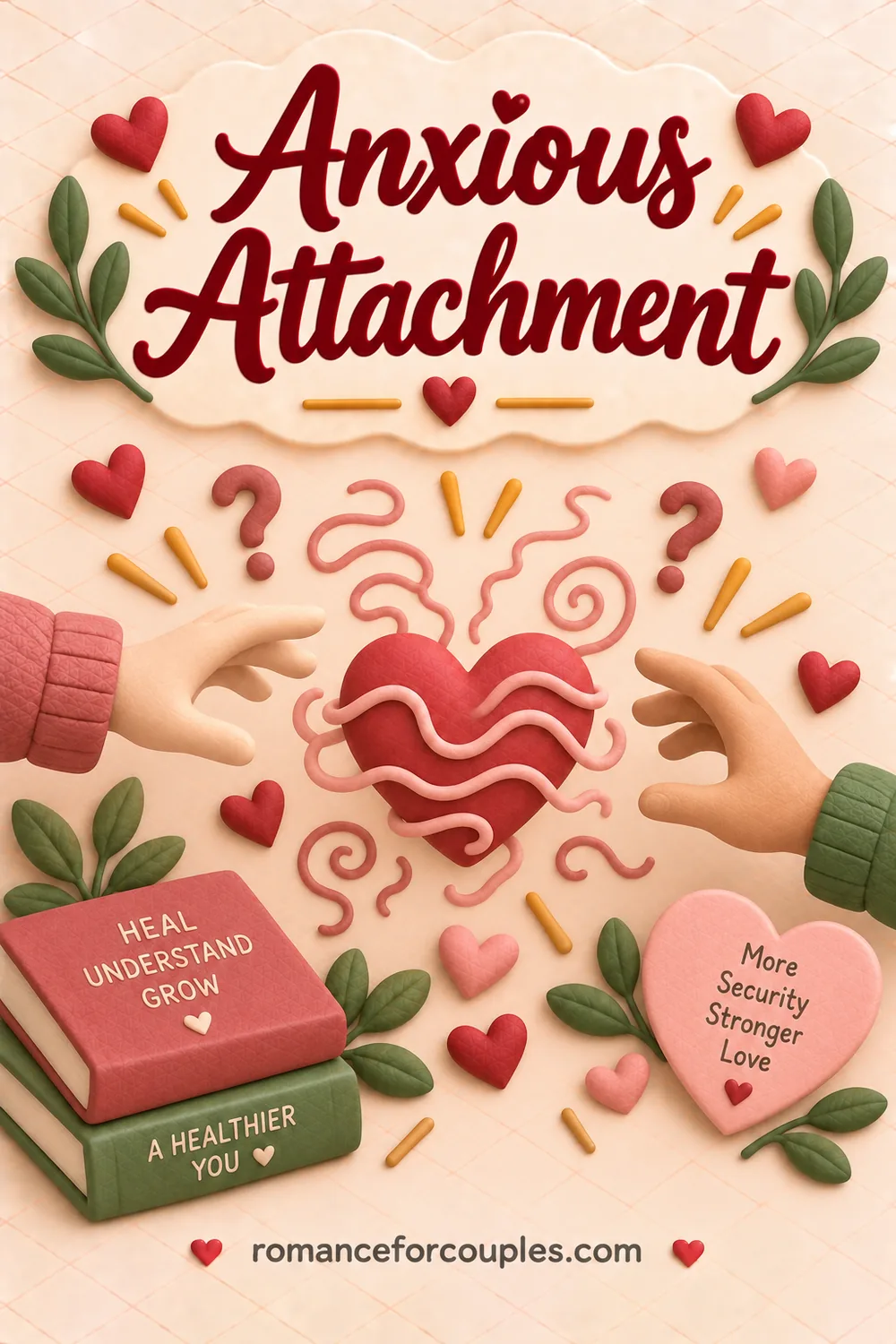
If you have ever stared at your phone waiting for a reply, replayed a conversation for hours looking for signs that something was wrong, or felt a wave of panic when your partner seemed a little distant, you may recognize something called anxious attachment. It is one of the most common patterns in adult relationships, and one of the most painful to live with, because it makes love feel both wonderful and precarious at the same time.
This guide explains what anxious attachment is, where it comes from, what it feels like from the inside, how it shows up in relationships, and, most importantly, what genuinely helps, both for the person with an anxious attachment style and for the partner who loves them. It draws on decades of attachment research, written in plain language. If you want to see where you fall, you can take our free Attachment Style Quiz, which measures the same two dimensions researchers use.
This article is for general understanding and reflection. It is not a diagnosis or a substitute for support from a qualified counselor or therapist.
What is anxious attachment?
Attachment theory began with the psychiatrist John Bowlby and the psychologist Mary Ainsworth, who studied how young children bond with their caregivers. They noticed that children develop different strategies for staying close to the people who look after them, depending on how reliably those people respond.
In 1987, researchers Cindy Hazan and Phillip Shaver showed that similar patterns appear in adult romantic relationships. Today, most researchers describe adult attachment using two dimensions:
- Attachment anxiety: how much you worry about rejection, abandonment, and whether you are truly loved.
- Attachment avoidance: how uncomfortable you feel with closeness and depending on others.
Someone with an anxious attachment style, sometimes called anxious-preoccupied, scores high on anxiety and low on avoidance. In other words, they want closeness very much, and they worry a great deal about losing it.
Signs of anxious attachment
Everyone has anxious moments in relationships. Anxious attachment is when these feelings are frequent, strong, and hard to calm. Common signs include:
- Worrying that your partner does not love you as much as you love them.
- Needing frequent reassurance that everything is okay.
- Feeling uneasy or panicky when a partner is slow to reply.
- Reading a lot into small changes in tone, mood or behavior.
- Replaying conversations and looking for hidden meanings.
- Feeling that your mood depends heavily on how the relationship is going.
- Fearing that conflict will lead to a breakup.
- Finding it hard to relax when apart.
- Putting a partner's needs far above your own to keep them close.
- Feeling jealous even when there is no clear reason.
None of these makes someone a bad partner. They are signs of a nervous system that has learned to stay very alert to any possible threat to a relationship.
What anxious attachment feels like from the inside
People with an anxious attachment style often describe love as intense and all-consuming. When things are going well, they feel wonderful: close, happy and secure. But that security can feel fragile. A late reply, a distracted conversation or a canceled plan can set off a flood of worry: "Did I do something wrong? Are they losing interest? Is this the beginning of the end?"
Researchers describe this as the attachment system becoming "activated." When the system senses a possible threat to closeness, it pushes the person to restore connection quickly, often through calling, texting, seeking reassurance or trying harder to please. Once reassurance comes, the anxiety eases. Until next time.
It can be exhausting. Many people with anxious attachment say the hardest part is knowing, logically, that their partner loves them, but not being able to feel it when the worry takes over.
Where anxious attachment comes from
Attachment styles develop from a mix of early experiences, later relationships and temperament. Researchers often link anxious attachment to caregiving that was loving but inconsistent: sometimes warm and responsive, sometimes distracted, overwhelmed or unavailable. A child in that situation learns that closeness is possible but not guaranteed, so they stay alert and work hard to keep it.
It is important to say that this is not about blaming parents. Many caring parents are stretched thin by stress, illness, work or their own history. Attachment patterns can also be shaped later in life by painful breakups, betrayal, or relationships where affection was unpredictable. And genes and temperament play a part in how sensitive a person is to begin with.
Protest behavior: what anxiety makes people do
When anxious attachment is activated, people often try to restore closeness in ways that can backfire. Relationship researchers sometimes call these "protest behaviors." Examples include:
- Calling or texting many times in a row.
- Keeping score of who replied last or who apologized first.
- Withdrawing or going silent to see if the partner notices.
- Threatening to leave in the hope of being reassured.
- Trying to make a partner jealous.
- Checking a partner's social media or phone.
These behaviors make sense from the inside. They are attempts to answer a frightening question: "Do you still care about me?" But they often push partners away, especially partners with a more avoidant style, which can confirm the very fear that started them.
The anxious-avoidant trap
Anxious and avoidant people are often drawn to each other. The avoidant partner's independence can feel exciting and mysterious; the anxious partner's warmth can feel flattering. But together they can fall into a painful cycle:
- The anxious partner senses distance and reaches for closeness.
- The avoidant partner feels pressured and pulls back.
- The anxious partner feels more anxious and reaches harder.
- The avoidant partner pulls back further.
Both people are reacting to feeling unsafe. The cycle can be broken, but usually only when both partners understand it. Naming it together, "I think we are in our cycle again," is often the first step.
What helps if you have anxious attachment
1. Learn your triggers
Notice what sets off your anxiety. Is it slow replies? A partner going out without you? A certain tone of voice? Writing down what happened, how you felt and what you did can reveal patterns you did not notice before.
2. Calm your body first
When the attachment system is activated, the body goes into alarm mode. Before you send a message, try something that calms your nervous system: slow breathing, a walk, cold water on your face, or calling a friend. Decisions made in a calmer state are almost always better.
3. Say what you feel, not what you fear
Instead of testing a partner or hinting, try naming your need directly and kindly: "I am feeling a bit insecure tonight. Could you give me a hug?" or "When I do not hear from you all day, I start to worry. Could you send a quick text when you are busy?" Clear requests are easier to meet than protest behaviors.
4. Build reassurance into the routine
Instead of searching for reassurance when anxious, agree on regular small rituals with your partner: a good morning text, a check-in call at lunch, a goodnight message. Predictable connection calms an anxious system more than big gestures do. Our collections of good morning messages and good night messages are full of ideas.
5. Question the story
When worry takes over, ask: "What else could explain this?" A slow reply might mean a meeting, a dead battery or a nap, not a loss of love. You are not trying to talk yourself out of your feelings, just to widen the options.
6. Invest in your own life
Friendships, hobbies, work you care about and time alone all help. When a relationship is your only source of security, every wobble feels like an earthquake. A fuller life gives you more places to stand.
7. Choose secure partners
Research suggests that people in relationships with consistently secure, responsive partners tend to become more secure over time. Warmth, reliability and clear communication are more attractive in the long run than the thrill of uncertainty.
8. Consider working with a professional
A counselor or therapist, particularly one experienced in attachment-focused or emotionally focused approaches, can help you understand where your patterns come from and practice new ones. Many people find this makes a real difference.
How to support a partner with anxious attachment
- Be consistent. Do what you say you will do, when you said you would do it.
- Communicate your plans. A quick "Busy afternoon, will call you tonight" prevents hours of worry.
- Reassure without resentment. Reassurance is not a sign that something is wrong; it is a way of saying "I am still here."
- Do not punish with silence. Taking space is healthy, but tell them you are taking it and when you will be back.
- Name the pattern kindly. "I can see you are worried. I am not going anywhere. Let's talk about it."
- Look after yourself too. Supporting an anxious partner does not mean giving up your own needs or independence.
Understanding each other's love languages can help as well. Many anxiously attached people feel especially reassured by words of affirmation and quality time. The Love Language Quiz can show you what matters most to each of you.
Can anxious attachment change?
Yes. An attachment style tends to hold steady over time, but it can shift. Researchers use the term "earned security" to describe people who began with an insecure attachment style and became more secure over time. The things that seem to help most are:
- A stable, supportive relationship with a responsive partner.
- Close, trusting friendships.
- Self-understanding, often through reading, reflection or journaling.
- Therapy or counseling.
- Practicing new behaviors, like direct communication, again and again until they feel natural.
Change is usually gradual. The worry does not disappear overnight, but it tends to become quieter, less frequent and easier to calm.
Anxious attachment compared with other styles
| Style | Anxiety | Avoidance | Typical feeling in love |
|---|---|---|---|
| Secure | Low | Low | "I can rely on you, and you can rely on me." |
| Anxious | High | Low | "I want to be close, but I am afraid you will leave." |
| Avoidant | Low | High | "I care about you, but I need my independence." |
| Fearful-avoidant | High | High | "I want closeness, and closeness scares me." |
When to seek help
If anxiety about your relationship is affecting your sleep, work, health or daily life, or if you feel stuck in the same painful patterns across several relationships, it is a good idea to speak to a counselor or therapist. And if a relationship ever makes you feel unsafe, controlled or afraid, please reach out to a local support line or emergency services. Anxious attachment is about fear of losing connection; it should never be used to excuse or explain away abuse.
Frequently asked questions
What is an anxious attachment style?
It is a pattern in which a person strongly wants closeness in relationships and often worries about rejection or abandonment. It is described by high attachment anxiety and low attachment avoidance.
What causes anxious attachment?
It is often linked to early caregiving that was loving but inconsistent, along with later relationship experiences and individual temperament.
Can someone with anxious attachment have a healthy relationship?
Absolutely. Many do, especially with self-awareness, clear communication and a supportive, consistent partner.
How do I stop being so anxious in my relationship?
Learn your triggers, calm your body before reacting, express needs directly, build regular reassurance into your routine, and invest in your own life. Therapy can also help a great deal.
Is anxious attachment the same as an anxiety disorder?
No. Anxious attachment describes a pattern in close relationships, not a clinical diagnosis. Someone can have an anxious attachment style without an anxiety disorder, and the reverse. If worry affects many areas of your life, not just relationships, it is worth talking to a doctor or mental health professional.
How do I know my attachment style?
You can reflect on your patterns, read about the styles, or take a quiz like our free Attachment Style Quiz, which measures anxiety and avoidance on a scale.