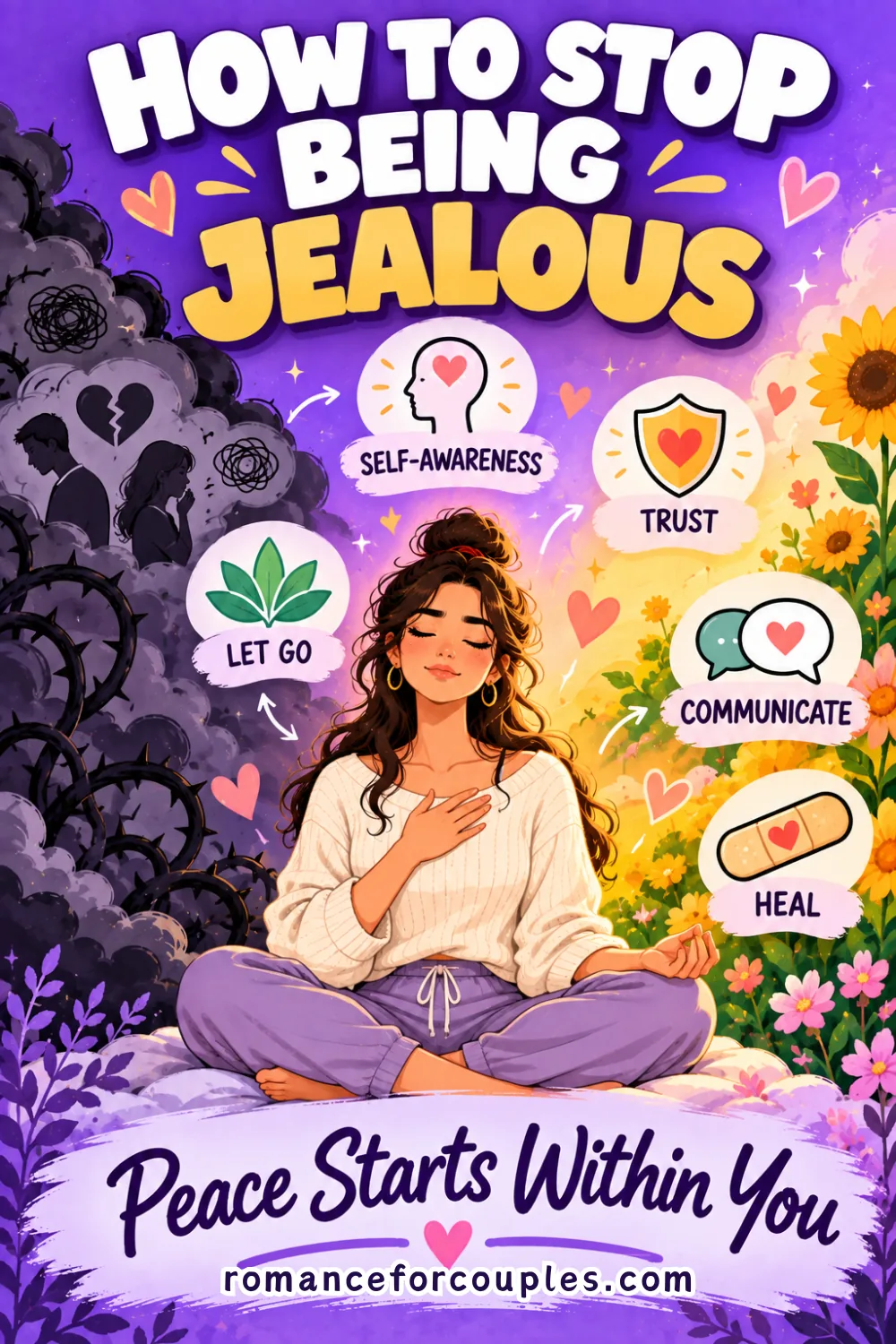
To stop being jealous, pause before you react, name the fear underneath the feeling, and check it against the facts you actually have. Then talk to your partner calmly about what you need, and build up your own confidence and life outside the relationship. Jealousy fades when you feel secure, not when you watch more closely.
If you've ever felt your stomach drop because your partner laughed at someone else's joke, you're in good company. Jealousy is a very human feeling, and having it doesn't make you a bad partner. This guide is for anyone who wants that feeling to stop running the show. You'll find what to do in the heat of the moment, how to calm jealousy over the long haul, words to use with your partner, and how to tell ordinary jealousy apart from something that needs outside help.
- Jealousy is usually fear of losing someone or something important, and it often grows from past hurts or insecurity rather than present facts.
- Pausing for a few minutes before you text, accuse, or check your partner's phone keeps one jealous moment from turning into a fight.
- Telling your partner what you feel and what would help works far better than asking them to prove they're innocent.
- A full life of your own, with friends, goals and interests, is one of the most reliable ways to feel less threatened in a relationship.
- Jealousy that leads to checking, controlling or threatening a partner has crossed a line, and calls for professional support.
Why do I get so jealous?
Most jealousy comes from fear: fear of being replaced, left, or found not good enough. The trigger is usually something small happening now, but the intensity often comes from somewhere older.
Understanding where yours comes from won't make it vanish overnight, but it does make it less mysterious and less powerful. Here are the most common roots.
- Past betrayal. If an ex cheated or lied, your mind may be trying to protect you from feeling that pain again, even with a partner who has done nothing wrong.
- Low self-worth. When part of you believes you aren't enough, every attractive or interesting person can look like a threat.
- Attachment style. People with an anxious attachment style often feel a strong pull to seek reassurance and can read distance as rejection.
- Unclear agreements. If you and your partner haven't talked about what's okay with friends, exes or social media, you're left guessing, and guessing feeds worry.
- Stress and tiredness. Jealousy tends to flare when you're already drained, lonely, or feeling unsure about other parts of life.
- Real warning signs. Sometimes your gut is reacting to actual secrecy or broken promises. That deserves an honest conversation, not self-blame.
If the anxious pattern sounds familiar, our guide to anxious attachment in relationships explains why reassurance can feel so urgent, and what helps.
Is jealousy normal in a relationship?
Yes, a flash of jealousy now and then is normal in a loving relationship. What matters is how often it shows up, how strong it gets, and what you do with it.
A small pang when your partner chats warmly with an ex at a party is ordinary. Stewing for days, demanding to see their messages, or telling them who they can and can't see is not. This table can help you sort out which side of the line you're on.
| Ordinary jealousy | Jealousy that's causing harm |
|---|---|
| Comes and goes, and passes within hours | Lingers for days or shows up constantly |
| You notice it and talk about it calmly | You accuse, interrogate, or give the silent treatment |
| You ask for reassurance once in a while | No amount of reassurance is ever enough |
| Your partner's friendships stay intact | You pressure them to drop friends or family |
| You respect their privacy | You check their phone, email or location in secret |
| It's about a feeling you want to manage | It becomes rules you expect your partner to follow |
If you see yourself in the right column, take heart. Noticing it is the first step, and the rest of this guide is built for exactly that situation.
What to do in the moment when jealousy hits
When jealousy hits, slow down before you act. The first ten minutes decide whether a jealous feeling stays a feeling or becomes an argument you'll regret.
- Put the phone down. Don't send the text, don't open their social media, don't check their location. Give yourself ten minutes first.
- Breathe slowly. A few long breaths, with the exhale longer than the inhale, take the edge off that racing feeling.
- Name it plainly. Say to yourself, "I'm feeling jealous right now." Labeling a feeling tends to shrink it a little.
- Find the fear. Ask, "What am I afraid will happen?" Usually the answer is something like "They'll find someone better" or "I'll be left out."
- Separate facts from story. Write down what you actually know (they're out with coworkers) and what you're imagining (they're having more fun without me, they like someone there).
- Ask what you need. Do you need a quick check-in, a little reassurance, or simply a distraction until they're home?
- Do something kind for yourself. Call a friend, take a walk, finish a chore, or put on a comfort show. Waiting calmly is easier when your hands are busy.
- Decide later. If you still want to talk about it after an hour, you'll do it from a much steadier place.
How to stop being jealous over the long term
Long-term jealousy eases when you feel secure in yourself and in your relationship. That security is built through small habits, not one big conversation.
Catch your thinking traps
Jealous minds love a few particular shortcuts. "Mind reading" assumes you know what your partner is thinking. "Fortune telling" jumps to the worst ending. "Comparing" lines you up against someone else and finds you lacking. When you notice one of these, gently ask, "What else could be true?" Your partner liking a coworker's post is far more likely to be politeness than a secret crush.
Build a life that's yours
When your whole world revolves around one person, any hint of losing them feels like losing everything. Keep friendships strong, pursue hobbies you love, set goals that have nothing to do with your relationship, and spend some evenings doing your own thing. A fuller life makes you more interesting company, and it quiets the fear.
Work on how you see yourself
Try keeping a short list of things you like about yourself and things you've done well lately, and add to it weekly. Notice how you talk to yourself in the mirror or after a mistake. If you'd never say it to a friend, don't say it to yourself.
Strengthen the relationship itself
Jealousy has less room to grow when you feel close and connected. Regular quality time, honest check-ins, and fair handling of disagreements all build the kind of steady trust that makes outside threats feel smaller. Our guide to trust in a relationship shows how that steadiness gets built one ordinary day at a time.
Agree on what's okay
Many jealous moments come from different assumptions. One partner thinks lunch with an ex is fine; the other thinks it's a big deal. Talk through the gray areas while you're both calm: friendships, exes, social media, nights out. Clear boundaries in a relationship protect both of you without becoming control.
Practice tolerating uncertainty
Nobody can be fully certain about another person's heart, and checking won't create that certainty. Each time you sit with a worry instead of acting on it, you prove to yourself that you can handle not knowing everything. That muscle gets stronger with practice.
How to talk to your partner about feeling jealous
Talk about jealousy as your feeling to share, not their crime to answer for. Choose a calm moment, keep it short, and ask for something specific.
Opening with an accusation ("Why were you texting her?") puts your partner on the defensive. Opening with honesty ("I felt a bit insecure last night, and I want to tell you about it") invites them closer. Here are a few ways to start.
Try saying: "I noticed I got jealous when you were talking with your ex at the party. I don't think you did anything wrong. I just want to be honest about it so it doesn't build up."
Try saying: "When you're out late and I don't hear from you, my mind goes to bad places. Would you be okay sending a quick text when you're heading home?"
Try saying: "I'm working on my jealousy. It would really help if you could tell me something you love about us once in a while."
Then listen. Your partner may have feelings of their own, including frustration if jealousy has caused trouble before. Thank them for hearing you, and don't expect a single talk to settle everything.
What to avoid saying
- "Prove it." Demands for proof treat your partner like a suspect and rarely bring the peace you're looking for.
- "You can't see them anymore." Ultimatums about friends are a form of control, even when they come from fear.
- "If you loved me, you'd..." This turns love into a test, and tests tend to create resentment.
How to stop being jealous of your partner's past
To let go of jealousy about a partner's past, remind yourself that their history is what brought them to you. You can't compete with memories, and you don't need to.
Past-focused jealousy (sometimes called retroactive jealousy) often shows up as a need to know every detail about exes, followed by feeling worse after you hear them. A few things help.
- Stop gathering details. Each new fact gives your imagination more to work with. Decide what you truly need to know, and let the rest go.
- Stay off old profiles. Scrolling through an ex's photos feeds comparison and almost never ends well.
- Focus on what's yours. The jokes, routines and memories you share belong only to the two of you. Build more of them.
- Ask for support, not reports. "Can you remind me why you're happy with us?" helps more than "Tell me everything about her."
Jealousy, phones and social media
Phones and social media give jealousy endless fuel, because they show you scraps of information without context. A like, a follow, or a late reply can all look meaningful when you're already anxious.
The healthiest approach is agreeing on norms together rather than monitoring each other. Some couples are comfortable sharing passwords; others prefer privacy. Both can work, as long as you've chosen it together and nobody is snooping in secret. If you catch yourself checking their followers or timing how long it takes them to answer, treat that as a cue to step away from the screen and return to the in-the-moment steps above.
It also helps to limit your own scrolling when you're feeling low. Seeing other couples' highlight reels can make your relationship feel smaller than it is.
When jealousy becomes controlling, and when to get help
Jealousy becomes harmful when it turns into control: checking, restricting, threatening or punishing a partner. At that point it isn't about love anymore, and it's worth getting help, whichever side of it you're on.
Signs to take seriously include tracking a partner's location without consent, demanding passwords, deciding who they can see, accusing them constantly, or reacting with rage. Our guide to red flags in a relationship covers these patterns in more detail.
If you recognize these behaviors in yourself, that awareness matters. A licensed counselor can help you understand where the fear comes from and learn new ways to cope. Couples counseling can also help when jealousy has worn down trust on both sides.
If you're on the receiving end and you feel afraid, watched, or controlled, you deserve support. You can reach the National Domestic Violence Hotline at 1-800-799-7233, or text START to 88788. More information is at thehotline.org. They're free and confidential, and you don't need to be sure it's "bad enough" to call.
Understand your attachment style to calm jealousy
Your attachment style shapes how you react when you feel a relationship is at risk, so knowing it can make jealousy much easier to understand and manage.
Someone with an anxious style might feel a strong urge to reach out and get reassurance right away. Someone with an avoidant style might shut down and pull away instead, even while feeling jealous inside. Neither is a flaw. They're patterns that formed for good reasons, and they can soften with awareness and practice. Our free attachment style quiz takes a few minutes and gives you a starting point for that understanding, plus a common language to share with your partner.
Frequently asked questions
Is it possible to stop being jealous completely?
Most people won't erase jealousy entirely, and that's okay. The goal is for it to show up less often, feel less intense, and pass without damaging your relationship. With practice, many people find jealous moments become brief flickers they can notice, name, and let go of, instead of storms that take over a whole evening or week.
How do I stop being jealous of my partner's friends?
Start by getting to know their friends, since people feel far less threatening once you know them. Keep your own friendships active so you're not waiting at home feeling left out. If something specific bothers you, share it calmly and ask for a small change, like a quick text, rather than asking your partner to spend less time with people they care about.
What's the difference between jealousy and envy?
Jealousy is the fear of losing something you have, like your partner's attention or affection, to someone else. Envy is wanting something another person has, like their career, looks or lifestyle. In relationships they often mix together, for example feeling envious of a coworker's confidence and jealous of the time your partner spends with them.
Should I check my partner's phone if I feel jealous?
Usually not. Secret checking rarely brings peace, because there's always another message or app to wonder about, and it damages trust if your partner finds out. If you have a real concern, raise it directly. If the urge is coming from anxiety rather than evidence, use calming steps and talk about the feeling instead.
Why do I get jealous when my partner has done nothing wrong?
Jealousy often comes from inside rather than from your partner's behavior. Past betrayals, insecurity, an anxious attachment style, or simple stress can all make your mind scan for threats that aren't there. Knowing this can be a relief, because it means the solution is partly in your hands, through self-care, reassurance and sometimes counseling.
How can I help a partner who gets jealous?
Offer steady, kind reassurance and keep your word about small things like texting when you're running late. Be open about your plans without accepting rules that limit your friendships or privacy. Encourage them to work on the roots of their jealousy, possibly with a counselor. If their jealousy becomes controlling or frightening, reach out for support.
Jealousy loses its grip when you understand it, so start there. Take our free Attachment Style Quiz to see how you tend to react when closeness feels at risk, then share what you learn with your partner. Calmer days usually begin with one honest, gentle conversation.