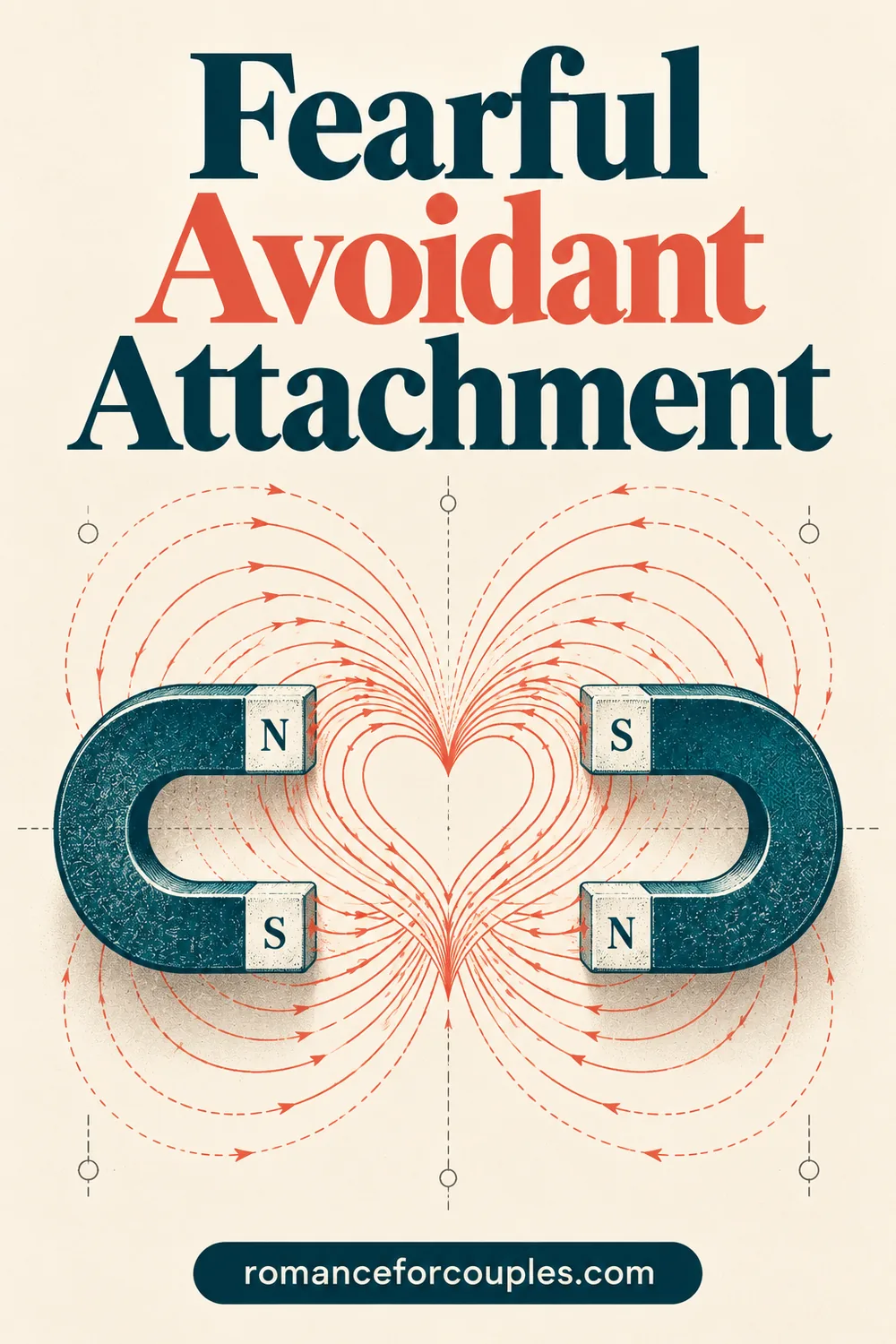
Maybe you have written a long, loving message and deleted it before sending. Maybe you fall for someone quickly and completely, and then, just as they start to fall for you, you feel an overwhelming urge to run. Or maybe you are the partner on the other side, trying to make sense of someone who says "Please do not leave me" one week and "I need space" the next. These are common experiences of fearful avoidant attachment, a pattern in which closeness is the thing a person longs for most and the thing that frightens them most.
This guide is written for both sides. It covers what fearful avoidant attachment is, how it relates to the term disorganized attachment, the signs, the push-pull cycle, where the pattern tends to come from, and practical steps that help people feel safer in love. It is gentle by design, because people with this style have often been through a lot already. If you want a starting point, our free Attachment Style Quiz scores you on anxiety and avoidance and shows where you fall among the four styles.
What is fearful avoidant attachment?
Researchers today usually describe adult attachment along two lines. One is attachment anxiety, meaning how much a person worries about being rejected or abandoned. The other is attachment avoidance, meaning how uncomfortable a person feels with closeness and depending on others. Most people sit somewhere in the middle of both, but some lean strongly one way or the other.
A fearful attachment style sits high on both. The person wants a close, loving bond and worries a great deal about losing it, which is the anxious part. At the same time, they feel unsafe when someone actually gets close, which is the avoidant part. Those two forces pull in opposite directions, and that tension is what makes this style so confusing to live with.
The name comes from the work of psychologist Kim Bartholomew. In the early 1990s, she suggested that adult attachment could be understood through two beliefs: how a person sees themselves, and how they see others. Someone with a fearful style often has doubts on both counts. Part of them believes they are not quite lovable, and part of them believes other people cannot be fully trusted. Wanting closeness while fearing it is a natural result of holding both beliefs at once.
Fearful avoidant or disorganized attachment: are they the same thing?
You will often see these two terms used as if they mean the same thing, and in everyday conversation that is mostly fine. But they come from different branches of research, and knowing the difference can reduce some worry.
- Disorganized attachment is a term that grew out of research on infants and young children. Mary Ainsworth's early work described three patterns in babies. Later researchers noticed that some children did not fit any of them. Their reactions to a caregiver seemed contradictory, for example moving toward a parent and then freezing or turning away. This fourth pattern was named disorganized.
- Fearful avoidant attachment is a label for an adult pattern in romantic and close relationships, measured by high anxiety and high avoidance together.
The two ideas overlap a lot, because both describe a person caught between reaching for comfort and fearing the person who might give it. That is why many writers use "disorganized" and "fearful avoidant" as near-synonyms. What matters most for everyday life is not the label but the experience: the pull toward closeness, the push away from it, and the confusion that follows.
How the four styles see themselves and others
Bartholomew's model is a helpful way to see how the fearful avoidant pattern differs from its neighbors. Think of it as two simple questions: "Am I worthy of love?" and "Can I count on other people?"
| Style | Bartholomew's label | View of self | View of others |
|---|---|---|---|
| Secure | Secure | Worthy of love | Generally reliable |
| Anxious | Preoccupied | Unsure of worth | Reliable, if I try hard enough |
| Avoidant | Dismissing | Capable on my own | Best not relied on |
| Fearful avoidant | Fearful | Unsure of worth | Longed for, but risky |
This is why a fearful avoidant person can relate to parts of both the anxious attachment guide and the avoidant attachment guide. They share the worry of the anxious style and the self-protection of the avoidant style, and they switch between the two depending on how close or far a relationship feels.
Signs of fearful avoidant attachment
Only a counselor or therapist who knows you well can really speak to your personal history, but these are common signs people with this style describe:
- Falling for someone intensely, then feeling trapped once the feeling is returned.
- Craving reassurance and then feeling uncomfortable or suspicious when it arrives.
- Believing a partner will eventually hurt or leave you, even when things are going well.
- Testing a partner's commitment, then pulling back when they pass the test.
- Strong emotional reactions to small events, followed by shutting down completely.
- Difficulty trusting kindness, sometimes wondering what the other person wants.
- Ending relationships suddenly to avoid being left first.
- Going back and forth about the same relationship many times.
- Feeling both lonely and overwhelmed, sometimes on the same day.
- A harsh inner critic that says you are too much, or not enough.
If several of these feel familiar, please be kind to yourself. These are not character flaws. They are protective habits that formed for good reasons, and they can soften with time and support.
The push-pull cycle, step by step
The most recognizable part of this style is a cycle that repeats in many relationships. It often looks something like this:
- Loneliness or longing builds, and the person reaches for connection.
- Closeness arrives. For a while it feels wonderful, even intense.
- As the bond deepens, fear rises: of being hurt, controlled, seen too clearly or left.
- The person pulls away, goes cold, picks a fight or suddenly ends things.
- Distance brings relief at first, then loneliness and regret.
- The longing returns, and the cycle begins again.
For a partner, this can feel like whiplash. For the person inside it, it can feel even worse, because they often do not understand why they keep doing it. Simply learning that this cycle has a name, and that many people share it, can be a real relief. Once you can see the steps, you can start to notice where you are in the cycle and slow it down.
How the fearful style feels day to day
Many people with a fearful avoidant style say love feels like an emotional storm. There is real hope and tenderness, sometimes more intense than other people seem to feel. There is also a quiet voice that says this will end badly. When a partner is distant, the anxious side lights up with worry. When a partner comes close, the avoidant side lights up with alarm. There is no position that feels fully safe.
Many also feel shame about their reactions. They may know, logically, that their partner is kind, yet find themselves reading a neutral comment as criticism or bracing for betrayal that never comes. They may feel like they are two different people depending on the day. It helps to understand that the nervous system, not the logical mind, is running the show in those moments. That is not an excuse, but it is a useful starting point for change.
Where fearful avoidant attachment comes from
Researchers often link this pattern to early experiences in which the people who were supposed to offer comfort were also, at times, a source of fear, confusion or unpredictability. A child in that situation faces an impossible problem: the instinct says go to your caregiver for safety, but the caregiver does not feel safe. Reaching out and pulling back at the same time is a very understandable response.
That might have come from obvious hardship, such as loss, neglect or a chaotic home. It might also come from quieter things: a parent who was struggling with their own pain, a family that moved often, or care that swung between warm and frightening. Later experiences can shape the pattern too, including hurtful relationships in adulthood, betrayal, or bullying.
None of this is about blame. Many parents who contributed to insecure patterns were doing their best with what they had, and some were carrying their own unhealed history. The point of understanding the roots is not to point fingers but to replace "Something is wrong with me" with "This makes sense, and I can learn another way."
Common triggers
Knowing what sets off the cycle is one of the most useful steps you can take. Triggers vary, but people with a fearful style often mention:
- Big steps forward, such as moving in, saying "I love you" or meeting family.
- Raised voices or sudden changes in a partner's mood.
- Feeling criticized, even gently.
- Unexpected distance, like a partner being unusually quiet.
- Being needed very much, which can feel like being trapped.
- Anniversaries or reminders of old hurts.
- Stress and tiredness, which lower everyone's ability to stay calm.
Try keeping a short note on your phone for a few weeks. Write down what happened, what you felt in your body, and what you wanted to do. Patterns often jump out quickly.
Fearful avoidant attachment with each style
With a secure partner
This pairing often has the most healing potential. A secure partner tends to stay calm during the push-pull, neither chasing too hard nor disappearing. Over time, that steadiness can teach the fearful partner that closeness can be safe. The secure partner will still need support, though, and should not be expected to carry everything alone.
With an anxious partner
Both people worry about being left, which can bring a lot of understanding. But when the fearful avoidant partner pulls away, the anxious partner may reach harder, which can make the fearful partner feel more trapped. A gentle daily check-in and an agreement that stepping back is not the same as leaving can help a great deal.
With an avoidant partner
Both partners may go quiet under stress, so important things can go unsaid for a long time. The fearful partner may also read the avoidant partner's distance as proof that they are not wanted. Setting a regular, low-pressure time to talk each week gives both people a safe place to share.
With another fearful avoidant partner
This can be the most intense pairing, full of deep understanding and big swings. It can work, especially when both people are actively learning about their patterns, but outside support from a counselor is often very valuable here.
What helps if this is you
1. Learn to notice the switch
The first skill is spotting the moment you flip from "I want you close" to "I need to get away," or the other way around. Common clues include a tight chest, a sudden wish to end a conversation, or a flood of critical thoughts about your partner. You cannot stop a switch you do not see.
2. Slow the pace on purpose
Fearful avoidant relationships often start fast and intense. Deliberately slowing things down, spending a little less time together early on, and taking milestones one at a time gives your nervous system a chance to keep up.
3. Pause before big decisions
If you feel the urge to end a relationship, block a number or send a harsh message, make a rule to wait at least a day. Many people with this style say their biggest regrets happened in the first hour of a strong feeling.
4. Put your pattern into words
Telling a partner, during a calm moment, something like "Sometimes when we get really close, I get scared and pull away. It is not about you" can change everything. Your partner is far less likely to take the distance personally, and you are less likely to feel alone with it.
5. Practice gentler self-talk
A harsh inner critic keeps the fear alive. When you notice thoughts like "I always ruin everything," try answering them the way you would answer a friend. This can feel silly at first, but it gradually loosens the shame that fuels the cycle.
6. Build safety outside romance
Steady friendships, a reliable routine, and activities that calm your body, like walking, stretching or time in nature, all give you more stable ground. The more safety you have in general, the less every relationship moment feels like life or death.
7. Work with a trauma-aware counselor
Of all the attachment styles, this is the one where professional support tends to help the most. A counselor or therapist who understands attachment and past hurt can help you make sense of your history at a pace that feels safe.
How to support a fearful avoidant partner
- Be predictable. Consistent words, plans and moods are deeply calming for this style.
- Stay steady during the push. When they pull back, try not to panic or punish. A calm "I am here when you are ready" is often enough.
- Do not force closeness during the pull. Let them set some of the pace, especially early on.
- Avoid ultimatums and raised voices. Anything that feels threatening can set off the urge to run.
- Celebrate small steps. A shared feeling or a conversation they stayed in, even when it was hard, is progress.
- Look after yourself. Loving someone with this style can be tiring. You are allowed to need support, and to have limits.
Trust grows slowly with this style, and it grows through many small, reliable moments rather than grand gestures. Our guide to trust in a relationship has more ideas on how that everyday trust is built.
Can fearful avoidant attachment change?
Yes, and many people are living proof of it. Attachment researchers call it "earned security" when adults start out with an insecure style and grow more secure through later experiences. For a fearful avoidant person, that often comes from a combination of a stable, patient relationship, trustworthy friendships, self-understanding, and professional support.
Progress rarely looks like a straight line. You may have months where things feel calm, then a stressful period where old patterns return. That does not mean you are back at the start. Each time you notice the cycle sooner, stay a little longer, or repair a little faster, you are building a new pattern alongside the old one.
When to reach out for extra support
This article is meant for reflection and understanding. It cannot diagnose anything. Please consider talking to a counselor, therapist or doctor if painful memories feel like they have a strong hold on you, if you often feel numb, disconnected or overwhelmed, or if relationship fears are affecting your sleep, work or health. And if any relationship involves threats, control or fear for your safety, that is not an attachment issue. Please contact a trusted person, local support services or emergency services.
Frequently asked questions
What is fearful avoidant attachment?
It is an attachment pattern in which a person both strongly wants closeness and feels unsafe when closeness happens. Researchers place it where high attachment anxiety and high attachment avoidance meet.
Is fearful avoidant the same as disorganized attachment?
They are closely related and often used interchangeably. Disorganized attachment comes from research on infants, while fearful avoidant describes a similar pattern in adult relationships.
Why does a fearful avoidant person pull away when things are going well?
For this style, closeness can feel risky as well as wonderful. As a relationship deepens, fear of being hurt or trapped can rise, and pulling away lowers that fear for a while.
Do fearful avoidants come back?
Often they do, because the longing for connection is real. Whether a relationship can work long term depends on whether both people understand the pattern and are willing to work on it together.
How rare is the fearful attachment style?
Research usually finds that secure attachment is the most common style in adults and that fearful avoidant is one of the less common ones, though the exact share varies from study to study.
Can a fearful avoidant person have a healthy relationship?
Yes. With self-awareness, a steady partner, clear communication and often professional support, many people with this style build secure, loving relationships.
How do I know if I am fearful avoidant?
Look for the pattern of wanting closeness and fearing it at the same time. Our free Attachment Style Quiz can also show whether you score high on both anxiety and avoidance.
If this guide sounded familiar, try the free Attachment Style Quiz. It takes a few minutes, shows your anxiety and avoidance scores on a simple chart, and tells you when you sit close to the line between two styles, which is common for people with a fearful pattern.