Attachment and relationships are closely linked: the way you learned to seek comfort as a child often shapes how you reach for, or pull away from, a partner as an adult. There are four main attachment styles (secure, anxious, avoidant and disorganized), and none of them is a life sentence. With awareness and practice, couples can build security together.
Maybe you've noticed that you panic when a text goes unanswered, or that you feel trapped when a partner wants more closeness. Those reactions aren't random. This overview explains what attachment is, how each style tends to show up in love, the difference between healthy attachment and over-attachment, and practical ways two people with different styles can help each other feel safe. Where a style deserves a deeper look, you'll find a link to our full guide.
- Attachment style describes the habits you use to seek closeness and handle the fear of losing it, and it usually takes shape through early bonds with a childhood caregiver.
- The four commonly described styles of attachment in relationships are secure, anxious, avoidant (often called dismissive avoidant) and disorganized (often called fearful avoidant).
- Healthy emotional attachment feels like a safe home base, while over-attachment feels like your sense of calm depends entirely on one person.
- Couples with different attachment styles can feel secure together when they learn each other's triggers and agree on simple ways to reconnect after stress.
- Attachment styles can shift over time, and many adults build what's called earned security through steady relationships, self-awareness and sometimes counseling.
What does attachment mean in a relationship?
In a relationship, attachment is the emotional bond that makes your partner feel like your safe place. It's the pull to be near them when you're stressed and the sense of comfort when they're around.
Attachment theory started as a way to describe how babies bond with the people who care for them. The basic idea is simple: a child who gets reliable comfort learns that the world is mostly safe and that other people can be trusted. A child whose comfort is unpredictable, distant or frightening learns other strategies to cope, like clinging harder or not asking at all.
Those early lessons don't disappear when we grow up. They become a kind of internal guidebook for closeness. In adult romantic attachment, the guidebook answers questions like: Will you be there when I need you? Is it safe to depend on you? What happens if I show you I'm upset? Most people never read their guidebook consciously; they just feel its rules in their gut.
How is attachment different from love?
Love and attachment overlap, but they aren't the same thing. Love is the warmth, care and admiration you feel for someone. Attachment is the bond that makes them your go-to person when life gets scary. You can love a friend you rarely see, and you can feel strongly attached to a partner during a rocky season when love feels faint.
In a healthy attachment relationship, the two work together. Love gives you reasons to stay close, and attachment gives you a safe base to return to. Early infatuation, by contrast, is mostly excitement and longing. It can feel like attachment, but the steady sense of safety usually takes months of shared experience to form.
Attachment theory and anxiety
Attachment fears and everyday anxiety often feed each other. Someone who already worries a lot may find that relationship uncertainty turns the volume up, and someone with an anxious attachment style may notice their general worry spikes whenever the bond feels shaky. Separating the two helps. Ask yourself whether the worry is about this relationship, this moment, or something larger in your life that's spilling over. If anxiety is heavy or constant, talking with a licensed counselor is a kind thing to do for yourself.
The four styles of attachment in relationships
The four main attachment styles are secure, anxious, avoidant and disorganized. Most people lean toward one, though many notice a mix depending on the relationship and how stressed they are.
Secure attachment
People with secure attachment are generally comfortable with closeness and with independence. They can ask for support without feeling needy and give space without feeling abandoned. Conflict doesn't feel like the end of the world, because they trust the bond will hold.
Anxious attachment
Anxious attachment shows up as a strong need for reassurance and a sharp sensitivity to signs of distance. A late reply or a quiet evening can set off worry that the relationship is in trouble. People with this style often love deeply and generously, but fear of losing a partner can make them reach harder when they feel unsure. Our full guide to anxious attachment covers what it feels like and what helps.
Avoidant attachment (dismissive avoidant)
Avoidant attachment, often called dismissive avoidant, shows up as a strong preference for self-reliance. Closeness can feel suffocating, so people with this style may pull back when things get emotional, change the subject, or focus on work. They do want connection; they just learned early that needing others wasn't safe or useful. Read more in our guide to avoidant attachment.
Disorganized attachment (fearful avoidant)
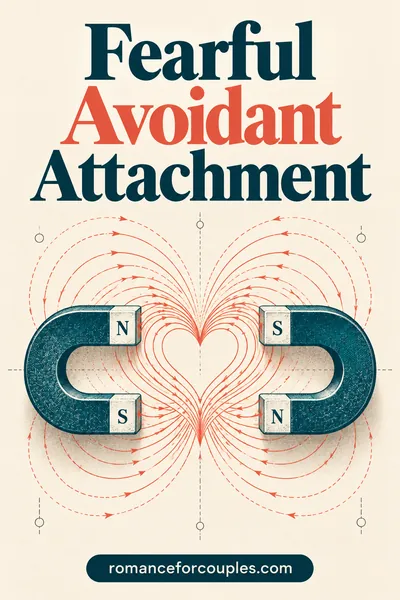
Disorganized attachment, which in adults is often called fearful avoidant, mixes both patterns. A person may crave closeness and fear it at the same time, moving toward a partner and then away. It often develops when a childhood caregiver was both a source of comfort and a source of fear. Our guide to fearful avoidant attachment explains this push and pull with care.
Attachment styles compared at a glance
This table sums up how each style tends to feel, act and need in a romantic relationship. Use it to spot patterns, not to label anyone.
| Style | Core belief | Under stress, tends to... | Feels safest when... |
|---|---|---|---|
| Secure | "I'm worthy of love, and others can be trusted." | Talk it through and ask for support | Both partners are honest and steady |
| Anxious | "I'm worthy if you stay close and prove it." | Seek reassurance, text more, worry | A partner offers clear, consistent reassurance |
| Dismissive avoidant | "I'm fine on my own; needing people is risky." | Withdraw, go quiet, focus on tasks | Space is respected and closeness isn't forced |
| Fearful avoidant | "I want love, but love can hurt me." | Swing between reaching out and pulling away | A partner stays calm, patient and predictable |
Curious where you land? Our free attachment style quiz asks short, everyday questions and shows which style you lean toward, with tips for each result. It's a gentle starting point for a conversation, not a diagnosis.
Healthy attachment vs. over-attachment
Healthy emotional attachment in a relationship feels like a secure base you can leave and come back to. Over-attachment feels like you can't function, feel calm or make choices without your partner's constant presence or approval.
Being attached is normal and good. Missing your partner, wanting to share news with them first, and feeling comforted by their voice are all signs of a healthy bond. The trouble starts when attachment becomes the only source of your stability.
Signs of healthy attachment
- You can be apart without panic. You miss each other, but you still enjoy your own friends, hobbies and time alone.
- Conflict feels survivable. Disagreements are uncomfortable, but you don't fear the relationship will end over one argument.
- You both have a voice. Each of you can say no, ask for something, or share a worry without fear of punishment.
- Support goes both ways. You lean on each other, and neither one is always the caretaker.
Signs of over-attachment in relationships
- Your mood depends on their mood. If they're quiet or busy, your whole day falls apart.
- You've dropped your own life. Friends, interests and goals have faded because the relationship takes all your energy.
- You need constant contact. Not hearing back quickly feels unbearable rather than mildly annoying.
- You fear any space. A partner's night out with friends feels like a threat rather than a normal part of life.
Over-attachment can overlap with codependency, where one partner's sense of worth rests on caring for or pleasing the other. Our article on the codependent relationship explores that pattern and how to find balance.
A quick, important note: needing reassurance is not the same as being controlled. If a partner monitors your phone, cuts you off from friends, makes threats or leaves you feeling afraid, that's not an attachment style difference. You can reach the National Domestic Violence Hotline any time at 1-800-799-7233, by texting START to 88788, or at thehotline.org.
How do different attachment style pairings play out?
Each combination of styles has its own typical rhythm, its own soft spots and its own strengths. Knowing your pairing helps you predict where things get bumpy and plan ahead instead of blaming each other.
| Pairing | What often goes well | Where it gets hard | A helpful habit |
|---|---|---|---|
| Secure + secure | Easy trust, quick repairs | Can coast and stop checking in | Keep a regular weekly talk even when things are fine |
| Secure + anxious | The secure partner's steadiness calms worry | The secure partner may tire of repeated reassurance | Offer reassurance before it is asked for |
| Secure + avoidant | Space is respected without drama | The secure partner may feel lonely | Agree on small, regular moments of closeness |
| Anxious + avoidant | Strong early pull and chemistry | The chase-and-retreat loop | Use time-limited breaks with a clear return time |
| Anxious + anxious | Lots of warmth and attention | Worry can feed worry | Build self soothing skills on both sides |
| Avoidant + avoidant | Calm, independent, low conflict | Feelings rarely get said, and distance grows | Schedule honest check-ins on purpose |
| Fearful avoidant + any | Deep longing for real connection | Mixed signals confuse both partners | Keep routines predictable and name the push-pull gently |
The anxious-avoidant loop, step by step
This pairing is so common it deserves a closer look. It usually runs like this: the avoidant partner gets busy or quiet, the anxious partner notices and reaches out more, the avoidant partner feels pressure and retreats further, and the anxious partner's worry spikes. Each one's coping move triggers the other's fear.
The loop breaks when either partner does the opposite of their habit. The avoidant partner can lean in a little before being asked ("Busy week, but I'm thinking about you"). The anxious partner can pause before the third text and try a calming activity first. One small change often softens the whole cycle.
How attachment shows up when you're dating
Attachment styles often show up most clearly in early dating, when uncertainty is high. The same text delay can feel like nothing to one person and like a crisis to another.
In attachment dating terms, anxious and avoidant people are often drawn to each other. The anxious partner reads the avoidant partner's calm as strength, and the avoidant partner enjoys the anxious partner's warmth, until things get serious. Then one chases and the other retreats, which makes each one's fears louder. This loop isn't anyone's fault, and naming it is often the first step to breaking it.
Secure partners can be a steadying presence for both styles, because they respond consistently and don't take every wobble personally. That said, any two people can build a secure relationship together; it just takes more conscious effort when both start out unsure.
What is a trigger?
A trigger is a moment that sets off an old fear more strongly than the situation calls for. For someone with an anxious style, a trigger might be a partner going quiet. For someone avoidant, it might be a partner saying "We need to talk." Knowing your triggers (and your partner's) helps you respond to the real moment instead of the old memory.
Signs a new partner leans secure
You can't diagnose a date, but you can notice patterns over the first few months. These signs often point toward someone who handles closeness with ease.
- Their interest is consistent. They don't run hot one week and cold the next, and plans they make tend to happen.
- They're comfortable with honest talk. When you raise a concern, they listen and respond rather than getting defensive or disappearing.
- They have a life of their own. Friends, interests and routines suggest they aren't looking for one person to fill every need.
- They can say "I was wrong." Owning a mistake without drama is one of the clearest signals of a secure attachment style.
If you lean anxious, a secure partner may feel "boring" at first because there's no roller coaster to ride. Give that calm a chance. Steadiness often turns out to be what you were hoping for all along.
How can couples with different attachment styles feel secure?
Couples feel more secure when both partners understand each other's needs, slow down during stressful moments, and agree on reliable ways to reconnect. It's less about changing who you are and more about building predictable comfort.
- Name your styles together. Take the quiz separately, then compare results over coffee. Talking about patterns is easier when they have a name.
- Share your triggers. Tell each other the moments that tend to set off worry or the urge to pull away. Be specific: "When you leave without saying goodbye" is more helpful than "When you're distant."
- Agree on a reconnection signal. A simple phrase like "I need twenty minutes, then I'll come find you" reassures an anxious partner and gives an avoidant partner room to breathe.
- Practice co-regulation. Co-regulation means helping each other calm down through presence: a steady voice, a hand on the back, slow breathing together. It teaches both nervous systems that closeness can feel safe.
- Build self soothing skills too. Each partner can learn ways to settle on their own, like a walk, journaling or a few minutes of quiet. This takes pressure off the relationship to fix every feeling.
- Repair quickly after conflict. A short "I'm sorry I snapped, I still love you" after a tense moment tells both of you the bond is intact.
- Keep promises small and reliable. Consistency is the language of security. Calling when you said you would counts more than grand gestures.
Try saying: "When I go quiet, it's not about you. I need a little space to think, and I'll come back to this tonight."
Try saying: "When I ask a lot of questions, I'm not trying to check up on you. I just feel better when I know we're okay."
Talking about these patterns is easier with good communication habits. Our guide to communication in relationships has more scripts for calm, honest talks.
Attachment in real life: five everyday scenarios
Attachment styles show up in ordinary moments far more than in big dramatic ones. Here is how they tend to look at different stages, with words you can borrow.
New couple: the slow reply
You sent a message at lunch, and by evening there's still no answer. If you lean anxious, your mind may write a whole story about losing interest. If you lean avoidant, you might not realize the silence mattered at all. Early on, it helps to talk openly about texting habits before they become a sore spot.
Try saying: "I'm learning that I get a little anxious when I don't hear back. You don't have to reply right away, but a quick 'busy, talk later' would really help me."
Long-distance: the call that got cut short
Distance turns small moments into big ones. A shortened call can feel like rejection to an anxious partner and like normal life to an avoidant one. Set a predictable call rhythm and a simple goodnight message, so the bond doesn't hinge on any single conversation. Our guide to making a long distance relationship work has more ideas for staying close across miles.
After a fight: one follows, one leaves the room
The anxious partner wants to fix it now. The avoidant partner needs to cool off first. Neither is wrong, and both can be met. Agree that the person who needs space names a time to come back, and the person who wants closeness lets them go without following.
Try saying: "I can see you need a break. I'm going to make tea and wait. Can we sit down together at seven?"
Busy parents: no time to connect
When kids, jobs and chores eat every hour, couples often stop turning toward each other. An avoidant partner may welcome the excuse, while an anxious partner quietly starts to feel invisible. Even ten minutes a night, sitting together after the house is quiet, gives the attachment bond something to hold onto.
Married for years: the comfortable drift
Long relationships can feel secure on the surface while both partners have stopped sharing anything vulnerable. A fearful avoidant partner may keep feelings tucked away to avoid rocking the boat. Bring back curiosity with a weekly ritual. Our check-in questions for couples make that conversation easy to start.
What does emotional availability look like?
Emotional availability means being willing and able to share feelings, notice your partner's feelings, and stay present when things get tender. It's a hallmark of secure attachment and something any style can grow.
- Listening without rushing to fix. Letting your partner finish before offering advice.
- Naming your own feelings. Saying "I'm feeling left out" instead of slamming cabinets.
- Staying in hard conversations. Not walking away mid-sentence, even when you'd like to.
- Offering comfort freely. A hug or kind word when your partner is down, without needing to be asked.
- Letting yourself be comforted. Accepting care is part of availability, too.
If closeness itself feels frightening, you might find our guide to fear of intimacy useful, along with our look at how couples build emotional intimacy over time.
Can your attachment style change?
Yes. Attachment styles are learned patterns, not fixed traits, and many adults move toward security over time. This shift is often called earned security.
Earned security tends to grow from a few sources: a steady, caring relationship (romantic or not), honest self-reflection about where your patterns came from, and practice responding differently when old fears show up. It doesn't mean you'll never feel anxious or want to pull back again. It means those feelings stop running the show.
Here's what that shift can look like in practice. A few years ago, a missed call might have sent someone with an anxious style into an evening of rereading old messages. Now they notice the flutter of worry, remind themselves their partner is at a work dinner, and go back to their book. Someone with a dismissive avoidant style might once have gone silent for a whole weekend after an argument. Now they say, "I need the afternoon, and I'll be back for dinner," and they mean it. Neither reaction is dramatic, and that's the point: security often looks quiet from the outside.
Many people also find it helpful to work with a licensed counselor or therapist, especially if early experiences were painful or frightening. Therapy for attachment styles often focuses on understanding old patterns, building self soothing skills and practicing new ways of connecting. Couples counseling can help two people learn each other's patterns in a safe, guided setting.
Small daily steps toward security
- Pause before reacting. When a fear rises, take a breath and ask, "Is this about now or about then?"
- Ask directly. Instead of guessing what a silence means, ask kindly.
- Notice what goes right. Each time your partner comes through, let yourself register it. These moments add up.
- Be patient with yourself. Old habits formed over years; new ones won't appear in a week.
Common mistakes couples make with attachment styles
Learning about attachment theory can bring real relief, but couples sometimes use it in ways that backfire. Watch for these traps.
- Using the label as a weapon. "You're just avoidant" ends a conversation instead of starting one. Talk about what happened and how it felt, not about what is wrong with your partner.
- Diagnosing instead of asking. Reading one article doesn't make anyone an expert on their partner. Ask how they experience closeness rather than telling them.
- Treating your style as an excuse. "I'm anxious, so you have to text me every hour" puts the whole job on your partner. Your style explains a reaction; it doesn't excuse every behavior.
- Expecting the other person to change first. Security grows faster when each partner works on their own side of the loop at the same time.
- Assuming a quiz is final. A quiz result is a snapshot. Stress, a new relationship or a hard year can make you look more anxious or avoidant than usual.
- Mixing up attachment and abuse. A partner who controls, threatens or frightens you isn't showing an attachment style difference, and you don't need to understand their past before keeping yourself safe.
A 30-day plan to build security together
Security is built through many small, repeated moments rather than one big talk. This four-week plan gives couples a simple structure to try.
- Week one: learn your patterns. Each partner takes the attachment style quiz alone, then you share results over a relaxed meal. Each of you names one thing you recognized in yourself and one thing that surprised you.
- Week two: map your triggers. Write down three moments that tend to set off worry or the urge to withdraw. Trade lists and pick one trigger each that the other will try to handle more gently.
- Week three: practice co-regulation. Once a day, spend five calm minutes together with no phones: a hug, a walk or slow breathing side by side. Pay attention to how your body feels before and after.
- Week four: rehearse repair. Agree on your reconnection phrase, a time limit for breaks and a way to say sorry. The next time things get tense, use the plan and talk afterward about what worked.
Questions to ask each other about attachment
Good questions about relationships help you understand each other's inner guidebook without judgment. Pick one or two a week rather than all at once.
- "Who comforted you when you were upset as a kid?" This gently opens the topic of childhood caregivers without demanding a full life story.
- "What does it feel like in your body when you're worried about us?" Naming physical signs helps both of you spot a trigger early.
- "What helps you calm down when you're stressed?" This tells you whether your partner leans on closeness, solitude or a mix.
- "What's one thing I do that makes you feel safe?" It points both of you toward what's already working.
- "When I pull away or reach out more, what do you think is happening?" Comparing stories reveals where you misread each other.
Frequently asked questions
What is the healthiest attachment style?
Secure attachment is considered the healthiest style because it allows comfort with both closeness and independence. Securely attached people can ask for support, give space, and handle conflict without feeling the relationship is at risk. That said, no style makes someone a bad partner, and people with anxious or avoidant tendencies can still build warm, steady relationships with awareness and effort.
What causes different attachment styles?
Attachment styles usually take shape in early life, based on how a childhood caregiver responded to a child's needs. Reliable comfort tends to build security, while unpredictable, distant or frightening care can lead to anxious, avoidant or disorganized patterns. Later experiences, including adult relationships, can also strengthen or soften these patterns, which is why styles are able to change over time.
Can two people with insecure attachment styles make it work?
Yes, many do. It helps when both partners understand their own patterns, share their triggers, and agree on ways to reconnect after stress. Patience and consistent small actions matter more than perfection. Some couples find that working with a licensed counselor gives them tools and a safe space to practice new habits together, especially when old fears feel strong.
Is it bad to be emotionally attached to your partner?
No. Emotional attachment is a normal, healthy part of love. Feeling comforted by your partner, missing them and wanting to share your life with them are good signs. It becomes a concern only when your entire sense of calm, worth or identity depends on them, or when you've stopped caring for your own friendships, interests and well-being outside the relationship.
How do I know my attachment style?
Notice how you react when you feel unsure in a relationship. Do you reach for reassurance, pull away, or swing between both? Do closeness and independence both feel comfortable? A short attachment style quiz can help you spot your leanings. Keep in mind that results describe tendencies, not fixed traits, and many people see a blend of styles.
What is the difference between disorganized and fearful avoidant attachment?
The terms describe closely related patterns. Disorganized attachment is the name most often used for children, while fearful avoidant is commonly used for adults. Both involve wanting closeness and fearing it at the same time, which can lead to mixed signals in relationships. Understanding the pattern and building a sense of safety step by step can help ease it.
Attachment isn't about fixing what's wrong with you; it's about understanding why love feels the way it does and choosing how you want it to feel. If you're ready to learn your own patterns, take our free attachment style quiz, ideally with your partner, and use the results to start a kind, curious conversation.