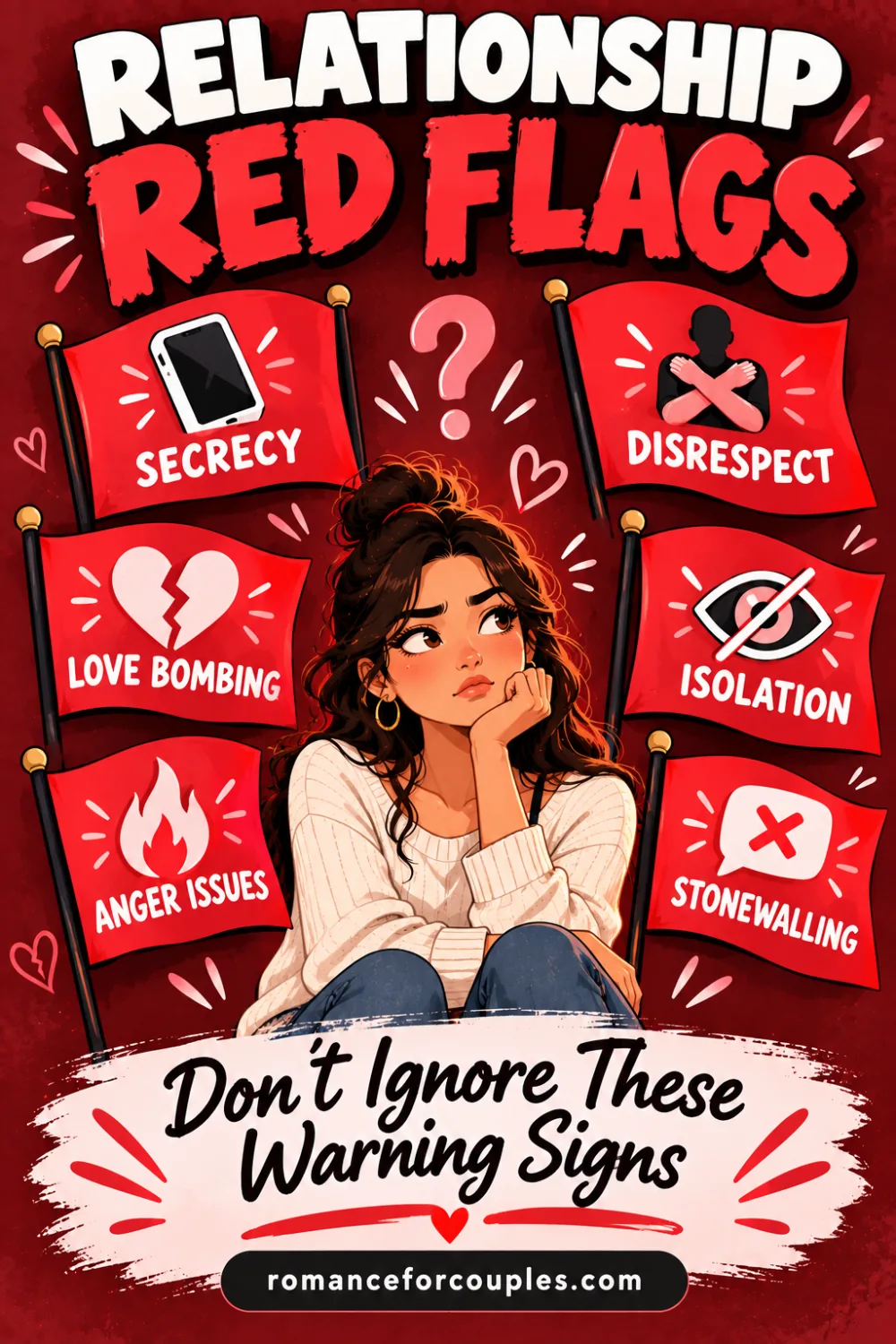
Red flags in a relationship are repeated behaviors that point to disrespect, control or dishonesty, such as lying, constant criticism, jealousy that limits who you see, or pressure to drop your friends. One bad day is not a red flag. A pattern that leaves you feeling smaller, anxious or unsafe is.
This guide is for anyone who has a quiet "something feels off" in the back of their mind, whether the relationship is three dates old or ten years deep. You'll get clear examples of early and long-term warning signs, a way to tell a real red flag from ordinary friction, words you can use to raise a concern, and honest guidance on when it's time to step away.
- A red flag is a pattern of behavior that harms your safety, freedom or self-worth, not a single mistake or a personality quirk you happen to dislike.
- Control often arrives dressed as care, so watch for "concern" that ends with you seeing fewer people, spending less of your own money or asking permission more often.
- The most useful test is how you feel over time: in a healthy relationship you feel more like yourself, while in an unhealthy one you feel more careful, more confused and more alone.
- Raising a concern calmly and watching how your partner responds tells you more than any checklist, because defensiveness, blame and punishment are red flags of their own.
- Threats, physical harm, or fear of your partner's reaction are never something to work through alone, and the National Domestic Violence Hotline (1-800-799-7233) is free and confidential.
What counts as a red flag in a relationship?
A red flag is a behavior that, if it keeps happening, wears down your safety, your independence or your sense of who you are. The key words are "keeps happening." Everyone snaps occasionally, forgets things, or has a sulky afternoon. A red flag is different because it shows up again and again, and it usually gets explained away.
It helps to think in three colors instead of one:
- Green flags are signs that things are working. Your partner keeps their word, apologizes without being pushed, and is happy when good things happen to you.
- Yellow flags are things worth watching and talking about. Maybe they're vague about their past, or they go quiet for a day after small disagreements. Yellow flags can turn green with honest conversation, or they can darken.
- Red flags are behaviors that cause harm or show a lack of respect for you as a separate person. They don't shrink on their own, and they rarely shrink because you tried harder.
If you aren't sure where a behavior falls, picture a close friend describing the exact same thing about their partner. Most of us are far clearer about other people's relationships than our own.
Early red flags when you're dating someone new
The earliest warning signs are often about speed and pressure. In the first weeks, people tend to show their best side, so anything troubling that slips through deserves a second look.
- Intensity that outruns the facts. Saying "I've never felt this way" on the second date, pushing to move in within weeks, or planning your future before they know your middle name. Big feelings are lovely, but rushing can be a way to lock you in before you see the full picture.
- Every ex is "crazy." If all of their past partners were the problem, ask yourself what role they played. People who have grown from old relationships can usually say what they'd do differently.
- Rudeness to people who can't push back. Watch how they treat servers, drivers and customer service staff. How someone treats people with less power is often how they'll treat you once the shine wears off.
- Boundaries tested early. You say you can't talk tonight and they call four times anyway. You say no to a plan and they keep asking until you give in. Small boundaries ignored now tend to become bigger ones ignored later.
- Stories that don't add up. Details shift, timelines change, and questions get met with irritation. You shouldn't need to be a detective at the start of a relationship.
- Love that comes with conditions. Warmth when you agree, cold distance when you don't. If affection feels like a reward you have to earn, pay attention.
For a fuller picture of how a good start feels, our guide to first date ideas that take the pressure off is a nice reminder that early dating should feel relaxed, not like a test you might fail.
Signs of a toxic partner in a long-term relationship
In established relationships, red flags are usually quieter and harder to name because they've become part of everyday life. A toxic partner isn't always loud or obviously cruel. Often the pattern is a slow shrinking of your world.
Control
Control can look like checking your phone, tracking your location without agreement, deciding what you wear, or needing to approve how you spend your own money. It often comes with a reason that sounds caring: "I just worry about you." Care respects your choices. Control replaces them.
Isolation
You see your friends less, and it isn't because you chose to. Maybe every night out leads to a fight, or your partner has a habit of finding fault with everyone you're close to. Over months, you end up with fewer people to talk to, which makes it harder to get an outside view.
Constant criticism and contempt
Teasing between partners can be affectionate. Contempt is different: eye-rolling, mocking your interests, calling you names, or putting you down in front of others and then saying you can't take a joke. If you've started editing yourself to avoid their reactions, that's worth noticing.
Twisting reality
Some partners regularly deny things that happened, insist you're remembering wrong, or turn every complaint you raise into a story about your flaws. Over time you may start doubting your own memory. Writing down events as they happen can help you keep your footing.
Punishing silence
Everyone needs space after an argument sometimes. Using silence as punishment is something else: days of being ignored until you apologize, often for something you didn't do. The message is "your connection to me depends on giving in."
Jealousy that restricts you
A flash of jealousy is human. Jealousy that leads to rules about who you can text, accusations without evidence, or anger when you have a life outside the relationship is a red flag. If you're the one struggling with jealous feelings, our guide on how to stop being jealous has calm, practical steps.
Red flag or just a rough patch? How to tell the difference
The difference usually comes down to pattern, responsibility and fear. A rough patch is temporary and both people own their part. A red flag repeats, gets blamed on you, and leaves you uneasy about how your partner will react.
| Normal relationship friction | Possible red flag |
|---|---|
| They're short-tempered during a stressful month at work and apologize later. | They're harsh most of the time and say you "make" them act that way. |
| They feel a twinge of jealousy and tell you honestly. | They check your messages, question your friends and limit where you go. |
| You argue about chores, money or family, and you both get heard. | Arguments end only when you give in, and your side is never really considered. |
| They need a few hours alone after a fight, then come back to talk. | They go silent for days to punish you until you apologize. |
| They forget plans now and then and feel bad about it. | They break promises constantly and act like your disappointment is the problem. |
| You feel annoyed with them sometimes. | You feel afraid of their reaction, or you hide things to keep the peace. |
That last row matters most. Feeling irritated with a partner is normal. Feeling scared of them is not, and fear deserves to be taken seriously even if nothing physical has happened.
If you'd like to compare your relationship against what healthy looks like, our article on the signs of a healthy relationship lists the everyday habits happy couples share.
Unhealthy relationships: what they do to you over time
Sometimes the clearest sign of an unhealthy relationship isn't something your partner does, but how you've changed. Your own feelings and habits are real evidence, even when you can't point to one dramatic moment.
Ask yourself whether any of these have become true:
- You walk on eggshells. You plan conversations in your head, choose words carefully, and time bad news around their mood.
- You've lost interest in things you used to love. Hobbies, friends or goals slipped away, and you're not sure when.
- You apologize constantly. Even for things that aren't your fault, because it ends the tension fastest.
- You keep secrets from friends. Not to protect your partner's privacy, but because you suspect your friends would worry.
- You feel relief when they're away. A calm, light feeling when your partner leaves for the weekend can be telling.
- You doubt your own judgment. You used to trust your instincts, and now you second-guess almost everything.
- Your body is tense. Headaches, poor sleep, a tight stomach before they come home. Stress shows up physically.
None of this means you did anything wrong. People adapt to stay safe and keep the peace. Noticing the adaptation is often the first step toward deciding what you want.
Could you be showing red flags yourself?
It takes courage to ask this, and asking it is a good sign. Anyone can pick up unhealthy habits, especially from past relationships or the homes they grew up in, and most can change them with honesty and effort.
A few habits worth checking in yourself:
- Keeping score. Bringing up old mistakes in every new argument so nothing is ever truly forgiven.
- Testing your partner. Pulling away or picking fights to see if they'll chase you. This often comes from fear of being left, and our guide to anxious attachment explains where that urge comes from.
- Checking up on them. Reading messages or tracking their location because you feel uneasy, rather than talking about the unease.
- Winning instead of resolving. Caring more about being right than about understanding what your partner is feeling.
- Going cold as a weapon. Withdrawing affection to make a point instead of saying what's wrong.
If you recognize yourself here, a licensed counselor can help you understand where these patterns come from and practice new ones. Owning your part is not weakness. It's the work that makes lasting love possible.
How do you bring up a red flag with your partner?
Choose a calm moment, describe one specific behavior, say how it affects you, and ask for a change. Then watch the response closely, because how your partner handles a fair concern is information in itself.
- Pick your timing. Not in the middle of a fight, not by text, and not when either of you is exhausted. A quiet evening at home or a walk works well.
- Name one behavior, not their whole character. "When you read my messages without asking" is something they can change. "You're so controlling" invites a defensive argument.
- Say how it lands for you. Use your own feelings as the center of the sentence. It's harder to argue with someone's experience than with an accusation.
- Ask for something specific. Make the request clear enough that both of you would know whether it happened.
- Listen to their side. There may be context you don't know. Listening doesn't mean you have to accept a bad explanation.
- Watch what happens next. Real change shows in the following weeks, not only in the apology.
Try saying: "I want to talk about something that's been bothering me. When you go through my phone, I feel like you don't trust me, and it makes me want to pull away. Can we agree that if you're worried about something, you'll ask me directly instead?"
Try saying: "I've noticed I see my friends a lot less than I used to, and I miss them. I'd like to go out with them on Thursdays again. I'm telling you because I want you to know, not because I'm asking permission."
Good responses sound like curiosity, an apology, or "I didn't realize, let's figure it out." Worrying responses sound like mocking, turning it back on you, threats to leave, or punishment later. If a calm conversation about one behavior isn't possible, that tells you something important.
It also helps to be clear with yourself about your limits before you talk. Our guide to boundaries in a relationship has examples you can adapt.
When is a red flag a sign to leave?
It's time to seriously consider leaving when the behavior continues after you've clearly asked for change, when you feel afraid, or when the relationship costs you your friends, your money or your sense of self. You don't need a dramatic final event to decide you've had enough.
Some situations call for more than a conversation:
- Any physical harm, including grabbing, pushing, blocking a doorway or throwing things near you.
- Threats, whether to hurt you, themselves, your pets, or to share private information.
- Financial control, like taking your paycheck, hiding accounts, or stopping you from working.
- Being cut off, such as having your phone taken or being stopped from seeing family.
- Pressure into anything you don't want, paired with anger or sulking when you refuse.
A calm note on safety. If any of this sounds familiar, you deserve support from people trained to help. The National Domestic Violence Hotline is free, confidential and available around the clock at 1-800-799-7233, or you can text START to 88788. You can also chat with them at thehotline.org. They can help you think through options and make a safety plan, even if you aren't sure what you want to do yet. If you're in immediate danger, call 911.
Leaving any relationship is hard, and leaving one that has worn you down can be even harder. If you do decide to go, our gentle guide on how to get over a breakup walks through the weeks after.
Checking in on your relationship's health
A regular, honest look at how your relationship is going helps you catch small problems before they become patterns. It doesn't have to be heavy. Think of it like noticing how you've been sleeping or eating.
Our free relationship quiz walks you through questions about communication, trust, conflict and respect, then gives you a snapshot of where things stand. It isn't a diagnosis, but it can put words to a feeling you've had trouble naming, and it makes a good starting point for a conversation with your partner or a counselor.
A few questions to ask yourself every so often:
- Do I feel free? Can I see friends, spend my money and make plans without fear of the fallout?
- Do I feel heard? When I raise something, does it get taken seriously?
- Do I like who I am here? Am I kinder, calmer and more confident than before this relationship, or less?
If the answers are mostly yes, you're in good shape, and our article on trust in a relationship has ideas for keeping it that way.
Frequently asked questions
What are the biggest red flags in a relationship?
The most serious warning signs are physical harm, threats, controlling who you see or how you spend money, constant put-downs, and making you afraid of their reactions. Repeated lying and refusing to take responsibility are also major concerns. Any one of these, especially when it happens more than once, deserves attention rather than excuses, and safety concerns deserve outside support right away.
Can a toxic partner change?
Some people do change, but only when they see the problem themselves and put in steady effort over time, often with help from a licensed counselor. Promises alone aren't change. Look for consistent new behavior across many months, especially in stressful moments. If the same pattern returns every time things get hard, believe the pattern more than the apology.
Is jealousy always a red flag?
No. Feeling a flicker of jealousy is a normal human reaction, and sharing it honestly can bring couples closer. It becomes a red flag when jealousy turns into rules, accusations, checking your phone, or anger about your friendships. The question is whether your partner manages their feelings themselves or expects you to shrink your life to calm them down.
Why do I keep ignoring red flags?
Most people ignore warning signs because they care about the person, hope things will improve, or fear being alone. Early warmth can make later problems feel like a temporary blip. Old relationship patterns from childhood can also make unhealthy behavior feel familiar. Noticing that you've been explaining things away is a strong first step toward seeing them clearly.
What is a yellow flag in dating?
A yellow flag is a behavior that isn't harmful on its own but is worth watching or talking about. Examples include being slow to reply for days, vagueness about their past, or getting a bit prickly when plans change. Yellow flags often clear up with an honest conversation. If they get worse or keep piling up, treat them more seriously.
How do I explain red flags to friends who like my partner?
Stick to specific examples instead of labels. Describe what happened and how it affected you, then ask for what you need, whether that's listening, a place to stay or help making a plan. Friends may need time to adjust. If they dismiss your concerns, find at least one person who believes you, or talk with a counselor or hotline advocate.
Trusting your gut is not dramatic, and wanting a relationship that feels safe and kind is not asking too much. If you'd like a gentle place to start sorting out how you feel, take our free relationship quiz on your own time and see what it shows you. Whatever you find, you deserve a love that makes your life bigger, not smaller.