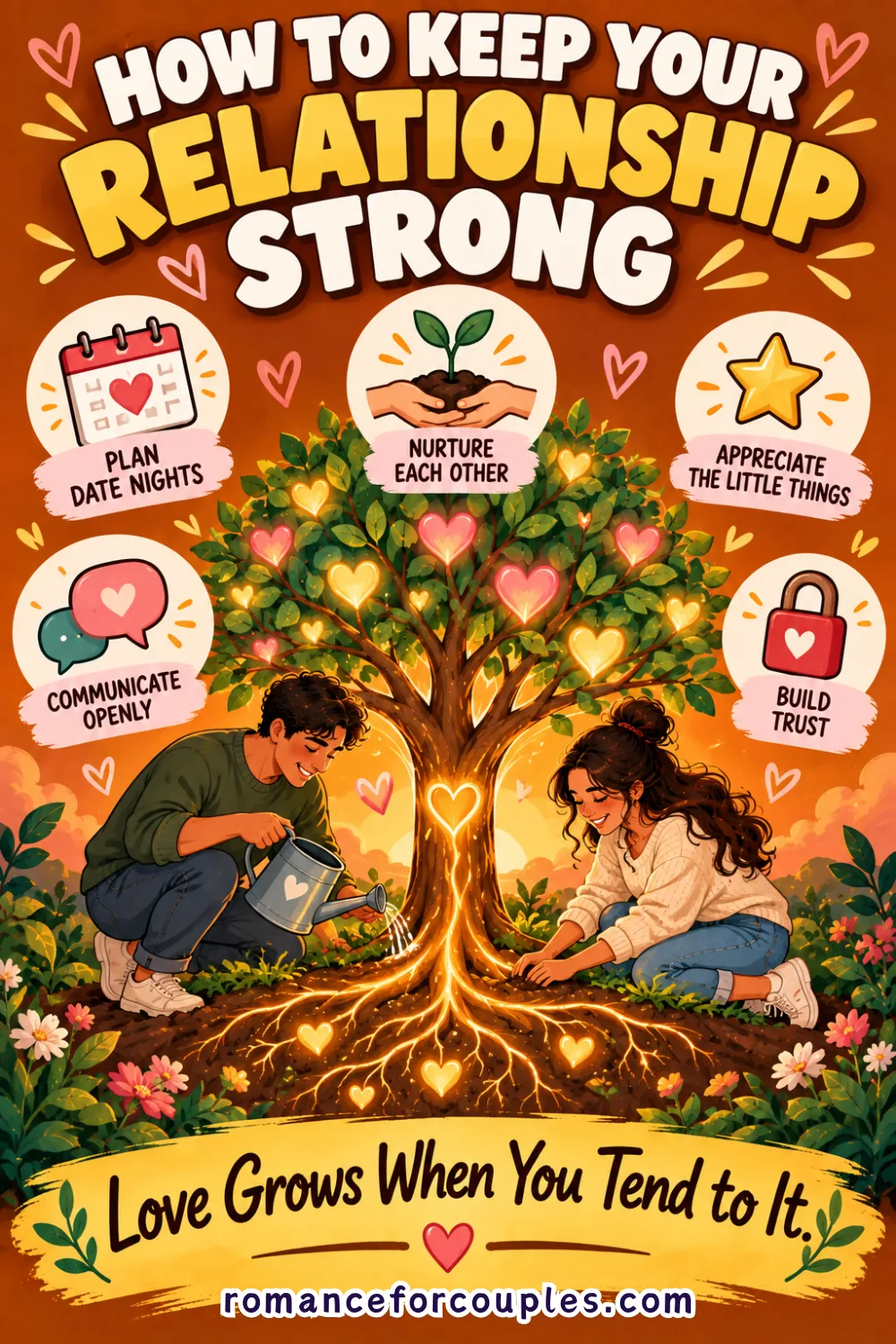
You keep a relationship strong through small habits repeated often, not grand gestures. Talk every day about more than chores, keep your word, say thank you out loud, fight fair and repair fast, and protect regular time for fun. Couples who last tend to tend their bond a little and often, like watering a plant.
This guide is for couples who feel good and want to stay that way, and for couples who feel a bit flat and want to improve the relationship before small gaps grow. You'll find daily, weekly and yearly habits, words to use in tricky moments, the relationship skills for couples that matter most, and the signs that tell you it's time to do more.
- A strong relationship is built mostly from ordinary moments, like a real hello at the door, a specific thank-you, and a follow-up question about your partner's day.
- Couples who repair quickly after a disagreement usually feel safer with each other than couples who simply avoid arguing.
- A short weekly check-in gives small worries a place to land before they harden into resentment.
- Appreciation lands best when you name the exact thing your partner did and why it mattered to you.
- Keeping a relationship strong means protecting play and new experiences, not only solving problems.
What makes a relationship strong?
A strong relationship is one where both people feel safe, wanted and on the same team, even on boring or stressful days. It isn't the absence of conflict. It's the presence of enough warmth, trust and goodwill that conflict doesn't knock you over.
If you set the details aside, most solid couples share a handful of foundations:
- Friendship. You actually like each other. You'd choose your partner's company on a free afternoon, and you know the little details of their world, from their coworker drama to their favorite snack.
- Reliability. You do what you say. Small promises kept, week after week, are what let your partner relax around you. Our guide to trust in a relationship goes deeper on how this grows.
- Respect. You speak to and about each other kindly, including in disagreements and including when the other person isn't in the room.
- Repair. When you hurt each other, someone reaches back quickly. Strong couples aren't the ones who never stumble; they're the ones who get back up fast.
- Shared direction. You have a rough picture of where you're heading together, whether that's a home, a family, a move, or simply growing old in the same place.
- Room to be yourselves. Each person keeps their own friends, interests and quiet time, so the relationship adds to your lives instead of swallowing them.
You don't need to score perfectly on all six. Most couples are naturally strong in a few and need practice on the rest, and that's exactly where habits come in.
Daily habits that keep a relationship strong
The daily habits that matter most take seconds, not hours: noticing, greeting, thanking and touching base. Done consistently, they make your partner feel seen, and that feeling is what carries couples through busy seasons.
- Make hellos and goodbyes count. Look up, stop what you're doing, and actually greet each other. A real hug at the door says "you matter more than my screen" without a word.
- Ask one real question a day. Skip "How was your day?" now and then and try "What was the best part of today?" or "Did that meeting go the way you hoped?" Specific questions get real answers.
- Say thank you for ordinary things. Taking out the trash, making coffee, handling a call you were dreading. Thanks for routine help keeps it from feeling invisible.
- Turn toward small bids. When your partner points out a funny post or sighs at the window, respond. These tiny reaches for connection add up fast, in either direction.
- Touch without an agenda. A hand on the back, a quick hug in the kitchen, holding hands on a walk. Easy affection keeps you physically close in a calm, friendly way.
- Share one worry and one good thing. A quick swap at dinner keeps you current on each other's inner life, not just the calendar.
- Put phones down for a set window. Even twenty minutes of face-to-face time in the evening feels different from two hours of sitting side by side scrolling.
- End the day kindly. Even after a rough evening, a simple "Goodnight, I love you" keeps the door open for tomorrow.
Pick two or three of these to start. Trying all eight at once usually lasts about a week; adding one at a time tends to stick.
How do you improve communication with your partner?
You improve communication by talking about feelings and needs instead of blame, listening to understand rather than to win, and checking that you heard correctly before you respond. It's less about saying more and more about saying things in a way your partner can actually take in.
Start soft
The first sentence of a hard conversation often sets the tone for the rest. Opening with criticism ("You never help") puts your partner on the defensive. Opening with what you feel and what you need gives them something to work with.
Try saying: "I'm feeling stretched thin this week. Could we sit down tonight and split up the weekend errands?"
Reflect before you reply
When your partner shares something, repeat the heart of it back before adding your view. It feels a little clunky at first, but it prevents a huge number of arguments that start from simple misunderstanding.
Try saying: "So it sounds like it wasn't really about the dishes, it was that you felt like I didn't notice how tired you were. Is that right?"
Ask for what you want, not just what you don't
"Stop being so distant" is hard to act on. "I'd love it if we could take a walk after dinner a couple of nights a week" is easy. Clear, positive requests give your partner a real chance to succeed.
Learn how your partner feels loved
Some people feel cared for through words, others through help, time, touch or small gifts. If you keep showing love in a way that doesn't quite reach your partner, it can feel like shouting into the wind. Our explainer on the five love languages is a friendly way to compare notes.
How to argue without damaging your relationship
You argue well by staying on one topic, avoiding insults and contempt, taking breaks when you're flooded, and coming back to repair. Disagreement is normal in every relationship; damage comes from how it's handled.
- Name the actual issue. "This is about the vacation plans" keeps you from sliding into every old grievance at once.
- Use "I" statements. Describe your experience instead of diagnosing your partner's character.
- Watch for contempt. Eye-rolling, mocking and sarcasm aimed at your partner hurt more than the topic ever could. If you catch yourself, stop and reset.
- Take a timeout when you're too heated. Agree on a phrase that means "I need twenty minutes," and always say when you'll come back.
- Look for the part you can agree with. There's almost always a piece of your partner's point that's fair. Saying so lowers the temperature fast.
- Repair, even if it's awkward. A joke, a touch, or a plain "I'm sorry I snapped" can turn an argument back toward teamwork.
- Follow up later. Once you've both cooled off, check whether anything still feels unresolved.
Try saying: "I don't want to win this, I want us to be okay. Can we start over?"
Some issues never fully go away. Many long-term couples have a few "forever topics," like tidiness or how often to see family. The goal with those isn't to solve them but to talk about them with humor and goodwill instead of fresh hurt each time.
Weekly and yearly rituals that build a good relationship
Rituals are habits with a set time, so they happen even when life is hectic. A weekly check-in, a regular date and a yearly look back are three simple ones that help couples build a good relationship and keep it that way.
| Ritual | How often | What it does for you |
|---|---|---|
| Morning coffee or tea together | Daily | Starts the day connected before the rush begins. |
| Weekly check-in | Weekly, 20 to 30 minutes | Catches small issues early and keeps plans in sync. |
| Date night, in or out | Weekly or every other week | Protects romance and fun from the to-do list. |
| Trying something new together | Monthly | Brings back the spark of discovering things side by side. |
| Big-picture talk | A few times a year | Lines up goals about money, home, career and family. |
| Anniversary look back | Yearly | Celebrates what you've built and what you've survived. |
How to run a weekly check-in
Keep it short, regular and kind. Many couples use the same four questions every week: What went well between us? What felt hard? Is there anything you need from me this week? What are we looking forward to? If you'd like a bigger menu of prompts, our list of check-in questions for couples is a good place to start.
Keep dates from becoming a chore
A date doesn't have to be dressy or far from home. A walk with takeout, a puzzle on the living room floor, or cooking a recipe neither of you has tried all count. What makes it a date is attention: phones away, no talk of bills, and the two of you actually focused on each other. If you're stuck for ideas, browse these date night ideas.
Relationship skills for couples worth practicing
Relationship skills are learnable habits, not personality traits. Anyone can get better at them with practice, and each one makes the others easier.
- Noticing. Paying attention to your partner's mood, stress and small wins. It's the root of almost every other skill on this list.
- Self-soothing. Calming yourself down when you're upset, through a walk, deep breaths or a break, so you can talk instead of react.
- Asking clearly. Putting a need into words before it turns into a complaint.
- Apologizing well. Naming what you did, acknowledging how it landed, and saying what you'll do differently. No "but."
- Accepting influence. Being genuinely open to your partner's ideas and willing to change course because of them.
- Setting limits kindly. Saying no or "not right now" without guilt or harshness. Clear boundaries in a relationship actually make closeness easier.
- Celebrating good news. Responding with real enthusiasm when your partner shares a win, instead of a distracted "nice."
- Forgiving small things. Letting minor slips go without filing them away for the next argument.
A useful exercise: each of you picks one skill you're already good at and one you want to grow. Share them, and agree to cheer each other on rather than point out slips.
How to improve a relationship that feels flat
To improve a relationship that has gone flat, start by naming it gently, then add small doses of attention, novelty and appreciation before tackling any big issues. Flatness is usually a sign of neglect, not of a broken bond, and the ways to increase closeness again are mostly small and free.
Lots of couples hit stretches where things feel more like roommates than partners. A new baby, a hard job, a move or caring for a parent can drain everyone. That's not a failure. It's a signal to turn back toward each other.
- Say it out loud, without blame. Something like "I miss us. Can we make a little more time for each other?" invites teamwork.
- Revive one old habit. Think back to something you did when you first got together, like a Sunday walk or a silly nickname, and bring it back.
- Add something new. Novelty is energizing. Take a class, try a new hike, or cook a dish from a country neither of you has visited.
- Increase appreciation on purpose. For one week, each of you says one specific thank-you a day. It feels forced on day one and natural by day five.
- Clear one practical stressor. Sometimes the flatness is really exhaustion. Splitting a chore differently or asking family for help can give you room to breathe.
- Talk about the bigger picture. Once you feel a little closer, ask where each of you wants the relationship to be a year from now.
If the distance feels deeper than a dull patch, our guide on how to reconnect with your partner walks through it step by step.
Try saying: "I've been so caught up in work that I think I've been half-present with you. I want to change that. What would help you feel closer to me right now?"
Signs your relationship needs more care
A relationship usually needs more attention when conversations stay on logistics, small irritations keep piling up, or one or both of you feel lonely together. Catching these signs early makes them far easier to fix.
- You only talk about schedules. If days go by without a single personal conversation, connection is running low.
- Little things feel huge. When a forgotten errand sparks a big reaction, there's often older hurt underneath.
- You avoid certain topics. Steering around money, family or the future to keep the peace can quietly widen the gap.
- Affection has faded. Fewer hugs, fewer kind words and less eye contact are early clues worth noticing.
- You'd rather be elsewhere. Staying late at work or always being busy can be a way of avoiding home.
- Arguments repeat with no repair. The same fight on a loop, with no making up afterward, wears down goodwill.
Seeing a few of these doesn't mean you're in trouble. It means it's time to apply the habits above with a bit more intention. A licensed couples counselor can help if you keep getting stuck in the same place, and going early is often easier than waiting until things feel desperate.
When it's about safety, not strength
Some patterns aren't a sign of a relationship that needs more care. If your partner threatens you, controls your money, phone or friendships, or makes you feel afraid, that's a safety issue, and it isn't yours to fix by trying harder. The National Domestic Violence Hotline offers free, confidential support at 1-800-799-7233, or you can text START to 88788 or visit thehotline.org.
See where your relationship is strongest
It's easier to know what to work on when you can see it. Our free Relationship Quiz walks you through short questions on communication, trust, conflict, fun, affection and your shared future, then shows which areas are thriving and which could use some love. Take it separately, then compare results over a cup of tea. For a fuller picture of what thriving couples do, see our list of signs of a healthy relationship.
Frequently asked questions
What is the most important thing for keeping a relationship strong?
There isn't one magic ingredient, but consistent kindness comes close. Couples who regularly notice each other, say thank you, keep small promises and make up quickly after disagreements tend to stay close for the long haul. Big romantic gestures are lovely, yet it's the everyday tone of how you treat each other that carries the most weight over time.
How can I make my relationship better without my partner feeling criticized?
Lead with warmth and with yourself. Share what you'd love more of, rather than what your partner does wrong, and suggest something you can do together. A line like "I miss our Sunday walks, can we bring them back?" feels like an invitation. Starting with a list of complaints usually feels like an attack, even when that isn't your intent.
How often should couples spend quality time together?
There's no perfect number, but most couples do well with a little daily connection and a longer stretch of focused time every week or two. Daily might be fifteen phone-free minutes after dinner. Weekly might be a date at home or out. What matters most is protecting the time so it doesn't vanish when life gets busy.
Can a relationship get stronger after a hard time?
Yes, many couples say a difficult stretch taught them how to lean on each other. Going through illness, job loss or a big argument and coming out the other side can build real confidence in the relationship. The key is repair: talking about what happened, owning your part, and making changes so you both feel safer afterward.
What are good relationship skills to learn as a couple?
Start with listening to understand, asking clearly for what you need, apologizing without excuses, and calming yourself down before a hard talk. Celebrating each other's good news and setting kind limits are worth practicing too. These skills can be learned by anyone at any stage, and each one makes the others easier to use in daily life.
When should we see a couples counselor?
Consider a licensed counselor if you keep having the same painful argument, if one of you feels lonely most of the time, or if trust has been broken and you can't move forward alone. You don't need to wait for a crisis. Many couples go for a handful of sessions simply to learn better ways of talking and come away with useful tools.
Strong relationships aren't lucky; they're looked after. Pick one small habit from this guide to start this week, then take our free Relationship Quiz together to see where you already shine and where a little extra attention could make you feel even closer.