What this quiz looks at
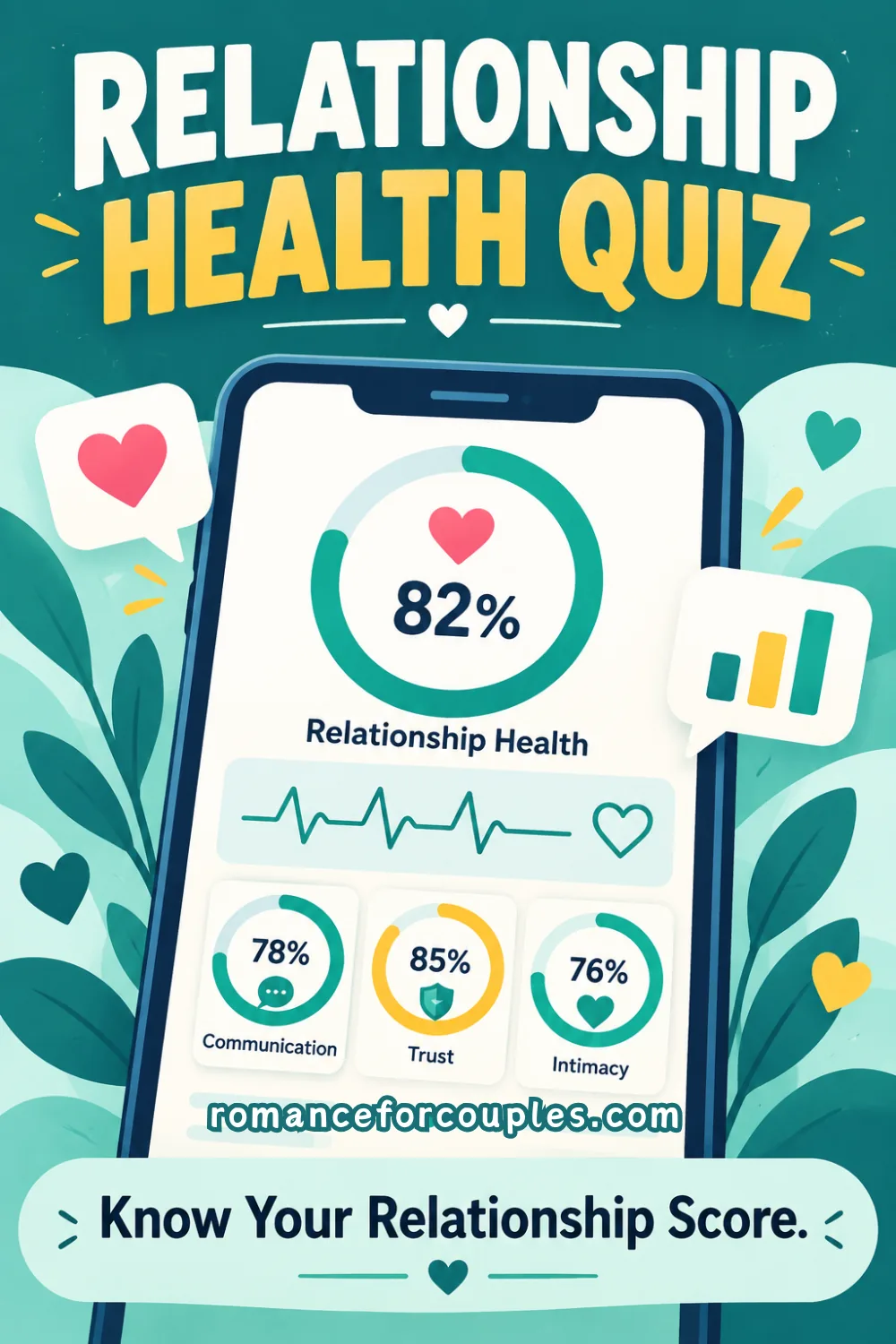
A healthy relationship is not one without problems. It is one where two people can talk, trust each other, get through disagreements, enjoy each other's company, feel cared for and move toward a future they both want. Those are the six areas this quiz explores, with five statements for each, so every area gets equal weight in your result.
You will not find questions about money figures, how long you have been together, or whether you live together. Plenty of happy couples do things differently from each other. The quiz focuses on how your relationship feels to you day to day, because that is what actually shapes a life together.
1. Communication
This area asks whether you can say how you really feel, whether you feel listened to, and whether your conversations go deeper than logistics. It also asks whether there are topics you quietly steer around because raising them feels like more trouble than it is worth. Avoided topics rarely disappear. They tend to come back later, often bigger.
2. Trust
Trust covers honesty, reliability and freedom. Do you believe what your partner tells you? Do they follow through? Can you lean on them when life gets hard? This area also includes one of the two safety statements, about whether your partner controls who you see, what you spend or where you go. Trust and control cannot live comfortably together, and our longer guide to trust in a relationship explains how trust is built, how it gets hurt, and how couples rebuild it.
3. Handling conflict
Every couple disagrees. What matters is how. The psychologist John Gottman spent decades watching couples talk through disagreements, and one of the clearest lessons from his work is that happy couples are not the ones who never fight. They are the ones who fight without contempt and who are good at repair: the small jokes, apologies and gestures that calm things down and bring two people back together. This area asks whether you can find solutions, whether arguments turn into insults or old grudges, whether you can take a break and come back, and whether one of you reaches out afterward. It also includes the second safety statement, about feeling afraid of how your partner will react.
4. Fun and friendship
Underneath romance, most lasting couples are good friends. This area asks whether you still laugh together, make time for things you both enjoy, and know what is going on in each other's world right now: the worries, hopes and small stories of the week. It also asks whether time together has started to feel more like routine than something you look forward to, which is one of the most common and most fixable problems couples face.
5. Affection and closeness
This area is about warmth, not the bedroom. It asks whether your partner shows affection in ways that feel good to you, whether you feel appreciated, whether days go by without a hug or a kind word, and whether you ever feel lonely even when you are together. It also asks about something Gottman called turning toward: when one partner reaches out for attention, even with a small comment about something out the window, does the other respond? Those tiny moments add up to a feeling of closeness over time.
6. Shared future
The last area asks whether you feel like a team heading in the same direction. Do you want mostly the same things out of the years ahead? Do you make big decisions together? Do you support each other's personal goals as well as your shared ones? Can you talk about practical plans, like where to live or how to handle money, without it turning tense? You do not need identical dreams, but it helps a great deal to know where they overlap.
How the scoring works
We want you to be able to check your own result, so here is exactly how the quiz adds things up.
Each of the 30 statements has five answers, and each answer is worth points:
| Your answer | Points for a regular statement | Points for a reversed statement |
|---|---|---|
| Strongly disagree | 1 | 5 |
| Disagree | 2 | 4 |
| Not sure | 3 | 3 |
| Agree | 4 | 2 |
| Strongly agree | 5 | 1 |
Regular statements describe something healthy, like "We still laugh together often," so agreeing earns more points. Reversed statements describe a sign of strain, like "I feel lonely even when we are together," so disagreeing earns more points. Ten of the 30 statements are reversed, spread across all six areas. Mixing the two directions keeps the quiz honest: someone who taps "Agree" on everything will not get a perfect score, because agreeing with the reversed statements counts against them.
Area scores. Each area has five statements, so an area can earn between 5 and 25 points. The quiz subtracts the lowest possible total and turns what is left into a percentage: an area where every answer was the healthiest possible shows 100%, and an area where every answer was the most strained possible shows 0%. If you answered "Not sure" to all five statements in an area, it would show 50%.
Your overall score. The same method is applied to all 30 statements together, which gives the big percentage at the top of your result. Because every area has exactly five statements, the overall score is simply the average of your six area scores, rounded to a whole number.
The labels. Your overall score falls into one of four bands:
| Overall score | Label | What it suggests |
|---|---|---|
| 80% and above | Thriving | Lots of warmth, trust and teamwork. Keep it up. |
| 65% to 79% | Strong, with room to grow | A solid base, with a few areas that would benefit from attention. |
| 45% to 64% | Worth some attention | Some important parts feel shaky right now, which is common in busy or stressful seasons. |
| Below 45% | Needs care | Several areas feel hard. The relationship deserves care, and outside support could really help. |
To give you a feel for the numbers: answering "Agree" to every regular statement and "Disagree" to every reversed one gives exactly 75%, which lands in "Strong, with room to grow." To reach "Thriving," a good share of your answers need to be the strongest ones.
How to read your result
Look at the bars before the big number. Two couples can both score 70% overall and have very different relationships. One might be strong everywhere with a small dip in fun, while the other might be excellent at friendship and affection but struggling with trust. The six bars show you where your score actually comes from.
Your strengths. The two areas with the highest scores appear under "What is going well," each with three ideas for keeping them strong. Strengths are worth protecting on purpose. Many couples put all their energy into problems and forget to keep doing the things that already work. If two areas tie, the one listed earlier in the quiz is shown first.
Areas to work on. Your lowest area always appears under "An area to work on," with three practical things to try together. If your second-lowest area also scores below 65%, it appears too, so you might see two. If even your lowest area scored 80% or more, the heading changes to "Something to keep an eye on," because in that case there is nothing to fix, only something to keep tending.
Your result is a snapshot. The quiz asks how things have felt over the last few months, but a hard week can still color your answers. A new baby, a move, a job change or an illness can pull any couple's scores down for a while. That does not mean something is broken. It means you are carrying a lot.
Your last score. When you finish, your browser remembers your overall score, its label and the date, so the start screen can say "Your last score was..." the next time you visit. That summary never leaves your device, and a "Forget it" button on the start screen clears it. Your individual answers are never saved at all.
Taking the quiz as a couple
The quiz is written from one person's point of view, and it becomes much more useful when both of you take it. Here is a simple way to do it:
- Take it separately. Use your own phones, at different times or in different rooms. Do not talk about your answers first. The goal is two honest pictures, not one negotiated one.
- Share the link, not your answers. The "Send to my partner" button on the result screen shares only the quiz page itself. None of your answers or scores are included, so your partner starts fresh.
- Compare when you are both calm. Pick a relaxed time, not the end of a long day or the middle of an argument. Put your two sets of bars side by side.
- Start with what matches. Talk first about the areas where you both scored high. It is a good reminder of what you have built together.
- Get curious about the gaps. If one of you scored communication at 85% and the other at 50%, that difference is the most valuable part of the whole exercise. Ask, "What makes it feel that way for you?" and listen without defending yourself.
- Choose one thing. Pick one tip from one area to try for the next two weeks. One small change you both stick with beats a long list you both forget.
If you would like lighter conversation starters to warm up with, the Couples Questions Game is a gentle way in, and the Love Language Quiz pairs well with a low affection score, since it helps you see how each of you prefers to be cared for.
What to do with a low area
A low score in one area can sting, but it is also useful: it tells you where a little effort will make the biggest difference. Here are some general principles that apply to any area.
- Go small and specific. "Communicate better" is too vague to act on. "Ten minutes of talking after dinner, phones away, four nights a week" is something you can actually do.
- Talk about the area, not about blame. Try "I scored us low on fun, and I miss us laughing together," rather than "You never want to do anything."
- Use a gentle start. Gottman's research highlighted how much the first few minutes of a hard conversation shape the rest of it. Starting softly, with "I" statements and a clear request, gives the talk a much better chance.
- Remember that areas are connected. Improving fun and friendship often softens conflict, because couples who feel close give each other more benefit of the doubt. Rebuilding affection often makes communication easier. You do not have to fix the lowest area head-on.
- Check again later. Retake the quiz in a couple of months. Seeing a bar move is encouraging, and if it has not moved, that is useful to know too.
Here are some ideas for each area, in addition to the tips on your result screen:
| Area | One small thing to try this week |
|---|---|
| Communication | Each share one high and one low from your day, every evening, for a week. |
| Trust | Make three small promises and keep every one, even the ones that feel trivial. |
| Handling conflict | Agree on a pause word you can both use to take a short break and come back calmer. |
| Fun and friendship | Plan one easy date, even a walk or a board game at home, and put it on the calendar. |
| Affection and closeness | Hug hello and goodbye every day, and mean it. |
| Shared future | Each write down three hopes for the next five years, then compare lists over dinner. |
For a wider look at what healthy couples tend to do day to day, our guide to the signs of a healthy relationship is a good companion to your result.
When to see a counselor
This quiz is a conversation starter, not a diagnosis, and it cannot tell you whether a relationship is right for you. A couples counselor or therapist can help in ways a quiz never will. It may be worth reaching out if:
- the same argument keeps coming back no matter how many times you talk it through;
- one or more areas has stayed low for months, even after you have both tried to change things;
- trust has been badly hurt, for example by an affair or a serious secret;
- you feel more like roommates than partners and cannot find your way back on your own;
- big life events, such as a loss, a new baby or a health problem, have left you both stretched thin;
- you are unsure whether to stay together and want help thinking it through.
Going to counseling is not a sign that a relationship is failing. Many couples go while things are still fairly good, simply to learn better tools. The earlier you go, the more there usually is to work with. It is also completely fine to see someone on your own if your partner is not ready.
There is one important exception. If you feel afraid of your partner, or they control your life, couples counseling is generally not recommended as a first step, because it can be unsafe to speak openly with that partner in the room. Talking privately with a trained advocate is a better place to start.
Safety comes first
Two of the 30 statements are there to check on something more important than any score: "I sometimes feel afraid of how my partner will react" and "My partner controls who I see, what I spend or where I go." Both are reversed statements, so agreeing with them lowers your score. But the quiz also treats them differently from everything else.
If you answer "Agree" or "Strongly agree" to either one, your result changes. It opens with a panel about your safety instead of a big percentage. That panel explains that this quiz can't assess safety, and that you deserve to feel safe, respected and free in your relationship. The couples tips and the "Send to my partner" button are left out, because working on communication skills is not the right answer to fear or control. Your area bars are still there if you want them, and nothing from that session is saved on your device.
If any of this sounds familiar, you do not have to figure it out alone. In the US, you can reach the National Domestic Violence Hotline any time, day or night:
- call 1-800-799-7233;
- text START to 88788;
- or chat online at thehotline.org.
The hotline is free and confidential, and you can reach out just to talk something through. You do not need to be sure what you are dealing with, and you do not need to have decided anything. Outside the US, please contact your local emergency services or a local support line. If you are ever in immediate danger, call 911 in the US or your local emergency number.
Control is not always loud. It can look like checking your phone, deciding who you can see, keeping you from money, or making you feel you need permission for ordinary things. Our guide to boundaries in a relationship explains the difference between healthy limits and control.
Frequently asked questions
How long does the quiz take?
About 4 minutes. There are 30 short statements, one per screen, and you tap one of five answers for each. The Back button lets you change an answer if you tap the wrong one.
What is a good relationship health score?
There is no pass or fail. A score of 80% or more is labeled "Thriving," 65% to 79% is "Strong, with room to grow," 45% to 64% is "Worth some attention," and below 45% is "Needs care." The bars for each area usually tell you more than the overall number.
Why did I not get a perfect score when I agreed with almost everything?
Ten statements are worded in reverse and describe a sign of strain, like feeling lonely together. Agreeing with those lowers your score, so the quiz rewards thoughtful answers rather than tapping the same button every time.
Should my partner take it too?
Yes, if they are willing. Each of you should take it separately, without discussing your answers, then compare your area scores together. The places where your scores differ often lead to the most useful conversations.
Does the "Send to my partner" link include my answers?
No. It shares only the link to the quiz page. Your answers and scores are not included, so your partner starts with a blank quiz.
Are my answers stored?
Your answers are never stored. They stay in the page while you take the quiz and disappear when you leave. The only thing kept is a short summary of your last overall score and its date, saved in your own browser, and you can clear it with the "Forget it" button on the start screen.
Can this quiz tell me whether to stay or leave?
No. It is a conversation starter, not a diagnosis, and it only reflects how things feel to you right now. For a decision that big, a counselor or therapist is a much better guide.
Why did my result show a safety message instead of a score?
That happens when you agree with either statement about feeling afraid of your partner or being controlled by them. Your safety matters more than any score. If that message appeared for you, please consider reaching out to the National Domestic Violence Hotline at 1-800-799-7233, or to a local support line outside the US.